About this guide: This article reflects common AC service patterns seen on Honda vehicles and general service experience in the Miami market. For an accurate diagnosis specific to your vehicle, contact the service team at Brickell Honda. Last reviewed: April 2026.
When a Honda's AC stops cooling in Miami, the temperature in the cabin can hit 120°F within 15 minutes of parking. The most common cause is a slow refrigerant leak — straightforward to address if caught early. Ignore it through summer and you may be looking at compressor damage instead, which requires much more involved repair. Call Brickell Honda Service at (786) 628-5077 to schedule an AC diagnostic. Our technicians will perform system pressure testing, refrigerant analysis, and leak detection with UV dye or electronic sniffer, then provide a written estimate before any repair work begins. If you're losing cold air over days rather than weeks, you probably have a leak — and in Miami's climate, that leak is getting worse fast.
This guide covers why Honda AC systems fail earlier in Miami than in cooler climates, what causes each type of AC failure, differences between older and newer Honda refrigerants (R-134a vs R-1234yf), which components fail most often on each Honda model, and when to choose a dealer over an independent shop for AC work.
The Four Most Common Reasons Your Honda AC Isn't Cold
Across the thousands of Honda vehicles we see each year in our Miami service bay, four problems account for the majority of AC failures. The ranking below reflects our technicians' actual diagnostic history — the order is meaningfully different from what you'll find in national automotive content because Miami's climate accelerates specific failure modes.
1. Refrigerant Leak (Most Common)
Every automotive AC system slowly loses refrigerant over years — it's a sealed system, but not a perfect one. In Miami, the combination of constant use (AC runs 10+ months per year here), high system pressures from extreme heat, and accelerated seal degradation means leaks show up sooner. The typical Honda in Miami needs a refrigerant service around the 6 to 8 year mark, while the same vehicle in a moderate climate might go 10 to 12 years.
Signs of a refrigerant leak:
- AC gradually gets less cold over weeks or months rather than failing suddenly
- AC blows cold only at highway speeds (not idling)
- Vents feel cool but not cold during peak heat
- Oily residue around AC lines or fittings (refrigerant oil circulates with refrigerant and deposits where leaks occur)
When caught early, a refrigerant leak repair is one of the more straightforward AC services. The critical factor is not letting the problem progress — a leak that's ignored through a Miami summer often leads to compressor damage that is far more involved to repair.
2. Failed Condenser (Miami's Signature AC Problem)
The condenser sits at the front of the vehicle, behind the grille, exposed to road debris, salt spray, and airborne contaminants. In Miami, two specific factors shorten condenser life:
Salt air corrosion. Vehicles driven frequently near Biscayne Bay, Key Biscayne, or along the Rickenbacker Causeway get continuous exposure to salt-laden air. Over 5 to 7 years, this corrodes the aluminum fins of the condenser and attacks the solder joints where the refrigerant tubes connect. We see condensers fail at 60,000 to 90,000 miles on coastal Hondas when the national average is over 120,000 miles.
Road debris impact. I-95, the Palmetto, and the Dolphin Expressway generate constant small rock impacts at the front of the vehicle. Modern Honda condensers have thinner fins than older designs (for better thermal efficiency), which means a single well-placed rock can puncture a tube and cause a slow leak.
Condenser replacement is a more involved repair than a simple refrigerant service. Access difficulty varies by model, with the Pilot and Odyssey generally requiring more labor than compact Hondas. Your service advisor will provide a written estimate specific to your vehicle.
3. AC Compressor Failure
The compressor is the heart of the AC system and one of the most labor-intensive components to replace. In Miami, compressors work harder and longer than in any other part of the country. A typical Miami Honda AC compressor cycles on within 30 seconds of starting the car on roughly 300 days per year. That's 10,000+ more cycles over a 10-year life than the same compressor in Chicago or Denver.
Compressor failure signs:
- Loud clicking, grinding, or squealing when AC is engaged
- AC clutch visibly not engaging when you turn on cool air
- Complete loss of cold air that happened suddenly (not gradually)
- Refrigerant system contaminated with metal particles (debris from failing compressor)
Compressor replacement is a significant repair because it's not just the compressor itself — debris from the failing compressor contaminates every line, receiver-drier, and expansion valve in the system. A proper repair requires flushing the entire refrigerant circuit, replacing the receiver-drier and expansion valve, and recharging with new refrigerant. This is why catching AC problems early matters so much in Miami's climate.
4. Blower Motor or Blend Door Failure
If your AC air is cold but airflow is weak, or if the temperature doesn't change when you adjust the controls, the issue is in the cabin's HVAC ductwork — not the refrigerant system. Miami's humidity causes blend door actuators to seize up earlier than in dry climates because moisture works its way into the tiny motor housings.
Blend door actuator replacement can be labor-intensive depending on which actuator failed — some sit deep inside the dashboard and require significant disassembly to reach. Our advisors will explain the specific labor involved for your vehicle before any work is authorized.
R-1234yf vs R-134a: Which Refrigerant Does Your Honda Use?
This is one of the most misunderstood parts of modern Honda AC service, and getting it wrong can damage your system. The two refrigerants are not interchangeable, have different system designs, and cost very differently to service.
Honda transitioned from R-134a to R-1234yf over several years, with the switch depending on model and sometimes even trim level. Here's the rough breakdown:
| Honda Model | R-134a (Older) | R-1234yf (Newer) |
|---|---|---|
| Civic | Through 2017 | 2018 and newer |
| Accord | Through 2017 | 2018 and newer |
| CR-V | Through 2016 | 2017 and newer |
| Pilot | Through 2018 | 2019 and newer |
| Odyssey | Through 2017 | 2018 and newer |
| HR-V | Through 2022 | 2023 and newer |
| Passport | Through 2018 | 2019 and newer |
| Ridgeline | Through 2017 | 2018 and newer |
The exact year of transition depends on your VIN — your Honda owner's manual or the sticker under the hood confirms which refrigerant your specific vehicle uses.
Why the Refrigerant Type Matters for Cost
R-134a is an older refrigerant still produced in large quantities. R-1234yf is the newer, more environmentally friendly alternative mandated for newer vehicles. The two refrigerants have different material costs and require different equipment, so service for a newer Honda with R-1234yf is not directly comparable to service for an older Honda with R-134a. Your service advisor can provide a written estimate specific to your vehicle.
Beyond material differences, the two refrigerants require completely different equipment. Shops that service R-134a cannot legally or safely recharge an R-1234yf system — the service machines, fittings, and oils are all different. Any shop claiming they can substitute R-134a in an R-1234yf system is not telling you something important. Honda-authorized dealers like Brickell Honda are equipped for both.
Why this guide is different: Most online AC repair articles treat all vehicles the same and ignore refrigerant specifics. Our Honda-certified technicians at Brickell Honda work on both refrigerant systems daily, have access to Honda Technical Service Bulletins that document model-specific AC issues, and can spot condenser or compressor problems that independent shops sometimes misdiagnose as "just needs a recharge." When a refrigerant recharge doesn't hold for more than a few months, something underlying is failing.
Miami Climate Patterns: Why Honda AC Fails Earlier Here
Honda engineers design AC systems to work across climates — from Arizona desert heat to Montana winters. But Miami combines several environmental stressors that, stacked together, accelerate AC component wear faster than any single factor would on its own. This is the part of the conversation you won't find in generic repair guides.
Extreme Duty Cycle
In Chicago, a typical driver uses their AC maybe 120 days per year. In Miami, we use it roughly 330 days per year. That's nearly 3 times the runtime on every component — compressor, condenser fan, blower motor, every seal and hose. When a manufacturer rates a compressor to last 150,000 miles under "typical" use, the assumption includes several months of zero AC operation annually. Remove those rest months and the effective service life drops accordingly.
Salt Air Corrosion
The condenser is the most visible victim of Miami's coastal air, but it's not alone. AC line fittings, the receiver-drier housing, and the metal bracketry that holds the entire system together are all susceptible to corrosion. Vehicles parked outdoors within two miles of Biscayne Bay — Brickell, Downtown Miami, Coconut Grove, Key Biscayne — face accelerated corrosion throughout the engine bay, with AC components among the most exposed.
Humidity-Driven Evaporator Fouling
The evaporator coil sits inside the dashboard, cooling air before it reaches the cabin vents. When your AC is running, the evaporator's surface temperature drops below the dew point of ambient air, causing water to condense and drip out the drain hose under your car. In Miami's 70%+ year-round humidity, the amount of water condensing is several times higher than in drier climates. Over years, this creates ideal conditions for mold and bacterial growth on the evaporator fins and in the HVAC ductwork — the source of the "stinky AC" problem so common in Florida.
More importantly, humidity combined with accumulated dust creates a biofilm that reduces the evaporator's ability to transfer heat. A partially-fouled evaporator can make your AC feel 15–20% weaker even when the refrigerant charge is perfect and the compressor is healthy.
Short-Trip Driving Doesn't Let the System Recover
A trip from Brickell to Wynwood and back is about 6 to 8 miles. In that time, an AC system barely reaches steady-state operation — it's still cycling hard to pull cabin temperature down from the 130°F+ interior temps reached after parking in Miami sun. Constant maximum-load short trips wear components faster than fewer, longer drives at steady load would.
When an Independent Shop Is Fine — And When It Isn't
We're not going to tell you the dealer is always the right choice. It isn't. There are AC jobs where an independent shop with a good reputation can do excellent work for noticeably less than dealer rates.
Independent Shops Work Fine For
- R-134a refrigerant recharges on pre-2018 Hondas
- Obvious physical condenser damage (rock hit, bent fins visible)
- Cabin air filter replacement
- Blower motor replacement where the symptom is clear (no airflow at all)
When Honda Dealer Diagnosis Matters
- R-1234yf systems (2018+ most Hondas). Many independents still aren't equipped for the newer refrigerant, and improper service risks system damage.
- Intermittent AC failures. These often trace to the HVAC control module, sensors, or software calibration — things that require Honda HDS to diagnose.
- Compressor replacements under warranty or Honda Care. Honda covers AC components under the new vehicle warranty for specific periods — only a dealer can process the warranty claim.
- "Recharge didn't hold" situations. A shop that recharges without finding the leak is just selling you a temporary fix. Leak detection with UV dye or electronic detection equipment is standard at the dealer.
- Hybrid AC systems (Civic Hybrid, Accord Hybrid, CR-V Hybrid, Insight). These use electric AC compressors that require high-voltage safety procedures independents often aren't trained for.
- AC systems with active Technical Service Bulletins (TSBs). Honda documents known issues with specific VIN ranges — only dealers have TSB access.
What to Expect During Your Honda AC Diagnostic
When you bring your Honda to Brickell Honda for an AC concern, here's what happens:
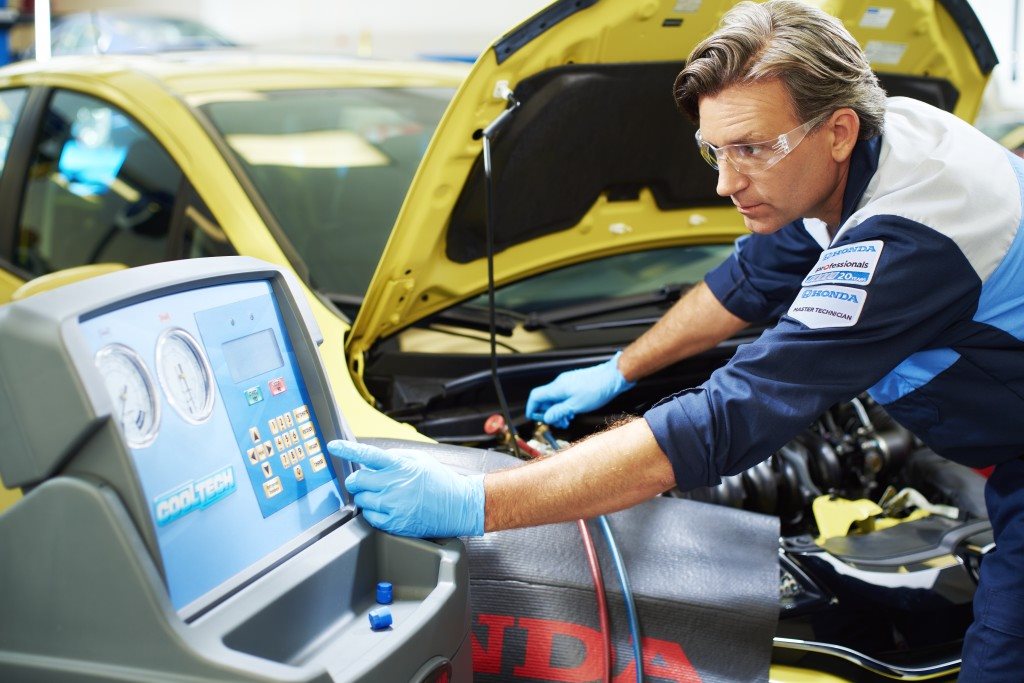
1. System inspection and pressure test. Our Honda-certified technicians connect manifold gauges to measure both high-side and low-side refrigerant pressures. These readings quickly indicate whether the system is low on refrigerant, has a failing compressor, or has a blockage.
2. Leak detection. If pressures indicate low refrigerant, we perform leak detection using UV dye tracer or electronic leak detector to pinpoint the exact source. This step is what independent shops often skip when they "just recharge it."
3. Electrical and control diagnosis. If pressures are normal but the AC still isn't cooling, the problem is typically in HVAC controls, sensors, blend door actuators, or blower motor. Honda HDS diagnostic equipment reads manufacturer-specific fault codes that generic scanners can't access.
4. Written estimate. Before any repair work begins, your service advisor provides a detailed written estimate covering exactly what's needed, OEM parts pricing, labor time, and total cost. You authorize repairs in writing — nothing happens without your approval.
5. Repair and verification. After repair, we verify system performance — measuring vent temperature, cycling the compressor, and confirming the leak is fixed. You leave with a cold AC and documentation of exactly what was done.
For current diagnostic pricing, ongoing service specials, and appointment availability, call our service department at (786) 628-0577 or view our current service specials.
Honda AC Problems by Model
Certain AC issues cluster around specific Honda models. These are patterns we see most often in our Miami service bay.
Honda Civic
Civics in Miami commonly come in with condenser failures starting around the 80,000 mile mark for vehicles parked regularly outdoors. The 10th generation Civic (2016–2021) in particular has a narrower condenser profile that's more vulnerable to debris damage. 2018 and later Civics use R-1234yf refrigerant, which requires different service equipment than older Civics.
Honda Accord
The Accord's AC system is generally robust, but we see a specific pattern on 2013–2017 models: the AC clutch coil on the compressor tends to fail before the compressor itself, causing the AC to stop engaging without the rest of the compressor being damaged. Catching this early means replacing just the clutch coil instead of the full compressor assembly — a much simpler repair.
Honda CR-V
The CR-V is the most common AC service visit we see, partly because there are so many of them on Miami roads. The 2012–2016 CR-V has a well-documented issue with the AC condenser's location, which exposes it to more road debris than on most vehicles. We commonly replace condensers at 70,000 to 90,000 miles on these.
The 2017 and newer CR-V moved to a much more durable condenser design and uses R-1234yf refrigerant, which requires different service equipment than earlier models.
Honda Pilot and Passport
These V6-powered SUVs have more complex dual-zone (and tri-zone on higher trims) climate systems with multiple blend door actuators and temperature sensors. Failures often show up as "one zone is cold but the other isn't" or "rear AC isn't working." Diagnostic is key here — the root cause could be a single actuator or a more involved wiring issue. Your service advisor will provide a written estimate after diagnostic.
Honda Odyssey
Odyssey owners frequently call about the rear AC failing before the front system. The Odyssey's long refrigerant lines to the rear evaporator are more prone to leaks due to constant flexing during normal operation (the minivan's body flex is meaningful). When the rear unit goes out first, it's often a leak at the rear line fittings or a failed rear expansion valve.
Honda HR-V and Fit
Smaller Hondas have simpler AC systems with fewer components to fail. Most AC issues on these are straightforward refrigerant leaks or condenser replacements. The main service consideration is that the HR-V's compact engine bay makes some AC jobs more labor-intensive than on a larger Honda.
Hybrid Models (Civic Hybrid, Accord Hybrid, CR-V Hybrid, Insight)
Hybrid Hondas use electric AC compressors that run independently of engine speed — which is great for cooling efficiency (AC still works when the gas engine shuts off) but requires completely different service procedures. Only shops with hybrid-qualified technicians should touch these systems. Refrigerant oil for electric compressors is different from conventional compressor oil, and mixing them damages the compressor.
Preventive AC Service Schedule for Miami Hondas
If you want to maximize your Honda AC's life in Miami's climate, here's the schedule our technicians recommend — specifically calibrated for Florida use, not the generic national maintenance schedule in your owner's manual.
| Mileage / Time | Service | Why It Matters in Miami |
|---|---|---|
| Every 15,000 miles or annually | Cabin air filter replacement | Humidity + pollen clogs filters twice as fast as northern climates |
| Every 2 years | AC system pressure check | Catches slow leaks before they become major repairs |
| Every 3 years | Evaporator cleaning / sanitization | Prevents the "stinky AC" problem and restores cooling efficiency |
| 60,000 miles | Full AC performance check + condenser inspection | Coastal Hondas often show early condenser wear around this mileage |
| 100,000 miles | Refrigerant recovery + recharge with new receiver-drier | Removes moisture accumulated in system over years |
Following this schedule significantly reduces the odds of a reactive major repair — a failed compressor or evaporator — by catching problems while they're still minor. Ask about our Wild Card Savings program when booking your service; Honda owners can save on recommended repairs when multiple services are needed.
Frequently Asked Questions
Why does my Honda AC only blow cold when I'm driving, not at idle?
This is the classic symptom of a low refrigerant charge. At highway speeds, airflow through the condenser improves, allowing the system to shed enough heat to produce cold air. At idle, with no airflow across the condenser beyond what the cooling fan provides, a weak system can't keep up. If this is happening, schedule an AC pressure test before the problem worsens — ignored low-charge situations typically lead to compressor damage within a few weeks of peak summer use.
How much does a Honda AC recharge cost?
This depends heavily on your Honda's model year. Pre-2018 Hondas use R-134a refrigerant, while 2018 and newer Hondas (for most models) use R-1234yf — a different refrigerant that requires different service equipment. If a leak is present, the repair scope is different from a straightforward recharge. Our service advisors provide written estimates for your specific vehicle after diagnostic — call (786) 628-057 for current pricing.
Can I just add refrigerant from a store-bought can to my Honda AC?
Technically yes for older R-134a systems, but we strongly recommend against it. Store cans often contain sealant additives that clog AC components and can damage the compressor. They also don't allow you to diagnose whether you have a leak — you're just masking the symptom. For R-1234yf systems (2018+ Hondas), do-it-yourself recharge is not practical because the refrigerant isn't sold in consumer-grade cans and requires specialized equipment.
Why does my Honda AC smell musty or moldy when I first turn it on?
This is the Miami humidity signature problem. Moisture accumulates on the evaporator coil and in the HVAC ductwork, providing a breeding environment for mold and bacteria. Evaporator sanitization service kills the biological growth, and replacing the cabin air filter regularly prevents it from returning. Running your AC with the compressor off for the last 2–3 minutes of your drive (fan-only mode) also helps by drying out the evaporator before you park.
How long should a Honda AC compressor last in Miami?
National averages suggest Honda AC compressors last 10 to 12 years or 150,000+ miles. In Miami, with AC runtime roughly 3 times higher than national average, expect 7 to 9 years or 100,000 to 130,000 miles on average. Compressors that receive proactive maintenance (regular pressure checks, cabin air filter changes, refrigerant service at 100k) tend to meet or exceed national averages. Neglected systems that see no maintenance until they fail completely often don't make it past 6 to 7 years in our climate.
Is it worth fixing a Honda AC that needs a compressor, or should I trade the car?
It depends on the vehicle's overall condition and value. A high-mileage Honda with multiple other maintenance items coming due may not justify the scope of a full compressor repair. But a relatively recent Honda with low-to-moderate mileage and no other significant issues often is — compressor replacement adds many years of AC life to an otherwise sound vehicle. We give honest trade-in appraisals alongside our repair estimates so you can make the decision with full information.
Can an independent mechanic service my newer Honda's R-1234yf AC system?
Some can, but many still can't. R-1234yf requires specific recovery and recharge equipment that represents a significant investment — smaller independent shops often haven't added it. Before taking a newer Honda to an independent, specifically ask whether they service R-1234yf systems and have the proper equipment. If the answer is uncertain, a Honda-authorized dealer is the safer choice for newer vehicles.
Why does my Honda AC work great for a week after recharge, then stop again?
A recharge that holds for a week or less means you have a significant leak. A recharge that holds for 6 months to a year might mean a tiny leak that's not worth chasing yet. A recharge that holds for 3 to 5 years is normal for a healthy system. If you need recharges every few months, something is actively failing — continuing to recharge without finding and fixing the leak is wasteful, and with newer refrigerants, environmentally significant.
Does Honda warranty cover AC problems?
Honda's basic new vehicle warranty covers AC components for 3 years or 36,000 miles. The powertrain warranty (5 years/60,000 miles) does not cover AC. Honda Care extended warranties can cover AC components if purchased — coverage specifics depend on which Honda Care plan level you have. If your Honda is approaching these limits and you're having AC issues, schedule service before the warranty expires. Our service team can tell you what's covered during diagnostic.
My AC blows cold but the air isn't coming out of all the vents. What's wrong?
This is almost always a blend door actuator failure. Small electric motors inside the dashboard open and close doors that direct airflow to different vents (face, feet, defrost). When one fails, airflow stops coming from certain vents or doesn't respond to controls. Common on Hondas with 100,000+ miles in Miami's humidity. Repair scope varies based on which actuator failed and how deep inside the dashboard it sits — your service advisor will provide a written estimate after diagnostic.
Schedule Your Honda AC Service in Miami
If your Honda's AC isn't cooling like it should, don't wait for it to fail completely in the middle of a July afternoon on I-95. Our Honda-authorized service center uses Honda HDS diagnostic equipment and EPA-certified refrigerant recovery machines for both R-134a and R-1234yf systems. We'll diagnose the actual cause, provide a written estimate before any work begins, and tell you what needs attention now versus what can wait.
Call our service department at (786) 628-0577 or schedule service online. Brickell Honda is located at 690 SW 8th St in Miami, serving Honda owners across Brickell, Downtown Miami, Coral Gables, Coconut Grove, Key Biscayne, and Little Havana. Check out our current service specials and view reviews on DealerRater (4,400+ verified reviews) and Cars.com to see what Miami Honda owners have said about their experience with our service team.
Service Department Hours
Monday through Friday: 7:00 AM to 6:00 PM
Saturday: 8:00 AM to 6:00 PM
Sunday: 9:00 AM to 3:00 PM
About Brickell Honda Service Center
Brickell Honda has served Miami-Dade County Honda owners since 1999. Our service department is staffed by ASE-certified and Honda-factory-trained technicians equipped with the Honda Diagnostic System (HDS), EPA-certified refrigerant recovery systems for both R-134a and R-1234yf, and OEM tooling required for accurate diagnosis of all Honda vehicles, including hybrid AC systems and Honda Sensing-equipped models. We've earned over 4,400 verified customer reviews on DealerRater, 373+ reviews on Yelp, and maintain an authorized Honda dealer designation from American Honda Motor Co.
This guide reflects diagnostic patterns observed in our Miami service bay and is intended as educational information. For diagnosis specific to your vehicle, consult a Honda-certified technician. All repair work is provided with a written estimate following diagnostic; pricing varies by model, VIN, and scope of repair. Published April 26, 2026 · Last reviewed April 22, 2026.