About this guide:This article reflects common check engine diagnostic patterns seen on Honda vehicles and general service experience in the Miami market. For an accurate diagnosis specific to your vehicle, contact the service team at Brickell Honda Last reviewed: April 2026.
A Honda check engine light can mean anything from a loose gas cap to a serious engine misfire. The pattern of the light is what matters most. A solid (steady) light is a diagnostic issue your Honda's computer wants addressed - drive carefully and schedule service within a week. A flashing (blinking) light is an active engine misfire causing damage in real time. Stop driving, arrange a tow, and call Brickell Honda Service at (786) 462-1041. Continuing to drive with a flashing light can cause significant catalytic converter damage that is much more expensive to fix than the misfire itself.
This guide covers the most common Honda check engine codes, what they mean by model (Accord, CR-V, Pilot, Odyssey, Civic, HR-V), Miami-specific causes you won't find in generic online articles, and what to expect when you bring your Honda in for professional diagnostic work.
Solid vs. Flashing: The Critical Difference
Many Honda owners don't realize the light is telling them two completely different things depending on how it behaves. This is the single most important thing to understand when you first see the light.
| Light Behavior | What It Means | What to Do | Urgency |
|---|---|---|---|
| Solid amber | Emissions-related fault detected. Engine is running but the computer flagged a sensor, valve, or system outside spec. | Drive normally but schedule diagnostic within 5–7 days. Avoid long highway trips. | Low–Medium |
| Solid + other warning lights (VTM-4, VSA, ABS) | Multiple systems affected. Often indicates a shared sensor failure or wiring issue. | Schedule service within 48 hours. Some systems may be disabled. | Medium |
| Solid + performance issues (rough idle, hesitation) | Fault is actively affecting engine operation - possible misfire or sensor failure. | Drive directly to service. Avoid highway speeds. | High |
| Flashing / blinking | Active engine misfire. Unburned fuel is entering the exhaust and damaging the catalytic converter by the minute. | Pull over when safe. Call for a tow. Do not continue driving. | Emergency |
If your check engine light is flashing right now: Pull over safely and shut the engine off. Every minute you continue driving with an active misfire, raw fuel pools in the catalytic converter and superheats it — damage that is significantly more expensive to repair than the misfire that caused it. Call our service department for guidance or to arrange a tow: (786) 628-0577.
The Six Most Common Causes We See
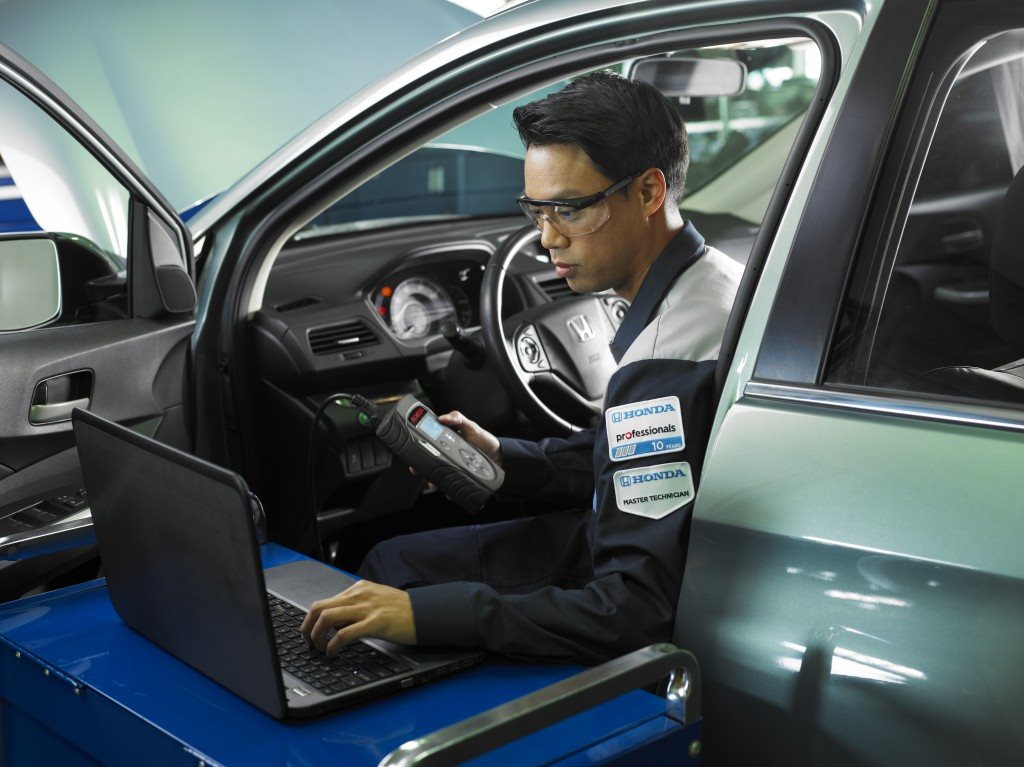
Across the thousands of Honda vehicles that come through our Miami service bay each year, six issues account for the majority of check engine lights. In rough order of how often our technicians diagnose them:
1. Loose or Failing Gas Cap
A surprisingly common cause - and often the cheapest fix. Modern Hondas monitor the evaporative emissions (EVAP) system for leaks. A gas cap that isn't clicked three times when tightened, or whose rubber seal has hardened in Miami's heat, can trigger code P0455 (large EVAP leak) or P0456 (small EVAP leak).
If the light came on shortly after a fill-up, tighten the cap until it clicks three times and drive 50 to 100 miles. If the light goes off on its own, you've solved it. If it returns, the cap itself may need replacement - one of the least expensive check engine light repairs possible.
2. Oxygen (O2) Sensor Failure
O2 sensors measure oxygen content in exhaust gases to fine-tune fuel delivery. They're consumables -most Honda O2 sensors last 60,000 to 100,000 miles under normal conditions. In coastal Miami, where salt-laden air accelerates corrosion of the sensor's wiring and connector, we often see them fail earlier. Common codes: P0131, P0133, P0135, P0151, P0155.
3. Catalytic Converter Efficiency Below Threshold
Code P0420 (Bank 1) or P0430 (Bank 2) means the converter is no longer scrubbing emissions efficiently enough. Sometimes this is the converter itself aging out; other times it's a symptom of a failing upstream O2 sensor - which matters because an O2 sensor repair is far less expensive than a full converter replacement. Proper diagnostic work distinguishes which one you actually need. It's also why we tell customers never to ignore a flashing check engine light: the misfire is actively cooking the converter.
4. Mass Airflow (MAF) Sensor Contamination
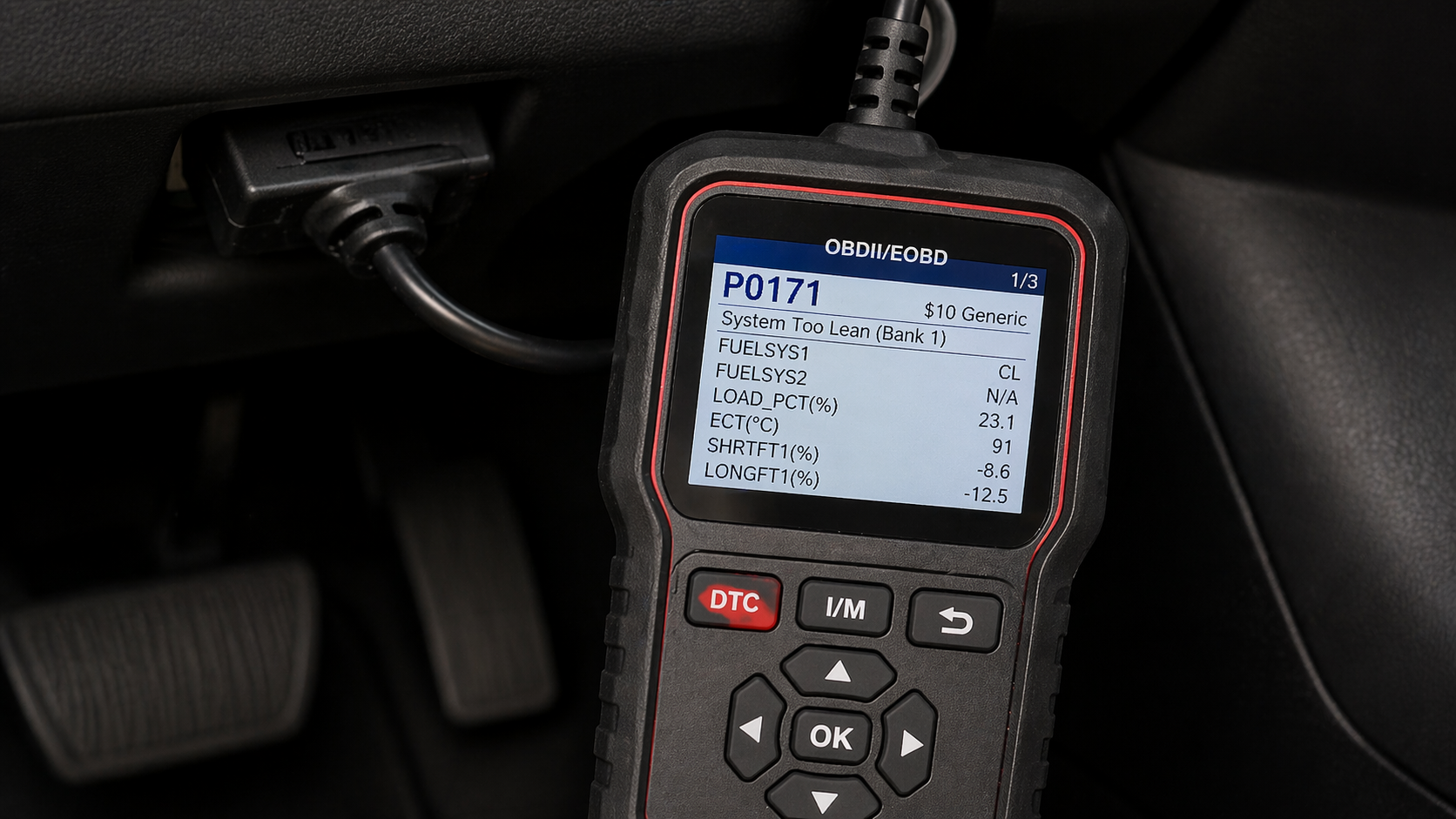
The MAF sensor measures incoming air so the ECU can calculate proper fuel delivery. Oil, dirt, or moisture on the sensor element throws off the reading. In most cases, cleaning (not replacing) the sensor resolves the issue. Common codes: P0171 (system too lean) or P0101 (MAF circuit range/performance).
5. Spark Plug or Ignition Coil Failure
A worn spark plug or failing coil-on-plug ignition coil is the typical cause of misfire codes P0300 (random misfire) or P0301 through P0306 (specific cylinder misfires). On Honda engines, this is often what triggers a flashing check engine light. Most modern Hondas run iridium plugs that last 100,000 to 120,000 miles, though we see them need replacement earlier on vehicles used primarily for short stop-and-go city driving.
6. EGR Valve or Purge Valve Malfunction
Emission control valves - the EGR (exhaust gas recirculation) and canister purge valves - get stuck open or closed over time, usually due to carbon buildup. Codes like P0401, P0441, or P1457 (common on older Accords and Civics) point here.
Honda Check Engine Codes Explained
When a Honda technician reads your check engine light, the scan tool returns one or more OBD-II diagnostic trouble codes (DTCs). Here are the codes we see most often on Hondas in our service bay, what they mean, and the typical component or system involved. Actual repair costs vary significantly depending on the specific cause - the same code can result from a minor sensor issue or a major component replacement, and only a proper diagnostic scan can tell which.
| Code | Meaning | Typical Cause | Repair Complexity |
|---|---|---|---|
| P0171 | System too lean (Bank 1) | MAF sensor, vacuum leak, fuel pressure | Minor to moderate |
| P0300 | Random/multiple misfire | Spark plugs, coils, fuel injectors | Moderate |
| P0301–P0306 | Cylinder-specific misfire | Failed coil or plug on that cylinder | Minor to moderate |
| P0420 | Catalyst efficiency below threshold (Bank 1) | Aging catalytic converter or upstream O2 sensor | Minor to major (varies widely) |
| P0430 | Catalyst efficiency below threshold (Bank 2) | Same as P0420, opposite bank | Minor to major (varies widely) |
| P0441 | EVAP purge flow incorrect | Purge valve, hose, or canister | Minor to moderate |
| P0455 / P0456 | EVAP system leak (large / small) | Gas cap, hose, purge valve | Minor |
| P0497 | EVAP low purge flow | Restricted purge system - common on Civics | Minor to moderate |
| P1457 | EVAP system leak (Honda-specific) | Canister vent shut valve - common on older Accords, Odysseys | Minor to moderate |
| P2646 | Rocker arm oil pressure switch (VTEC) | VTEC oil pressure switch failure | Moderate |
A few notes on this table. "Repair complexity" is a rough indicator of labor time and parts scope - a minor repair might involve a single sensor or valve, while a major repair could mean a full catalytic converter assembly with multiple related components. Actual pricing at dealer rates differs from independent shop rates, and a written estimate is the only way to know what your specific repair will cost. We provide one before any work begins.
Also worth knowing: the generic OBD-II code is only half the story. Honda vehicles log Honda-specific manufacturer codes that only the Honda HDS (Honda Diagnostic System) can read - the same equipment our technicians use. Hybrid components, VTM-4 all-wheel drive, CVT transmission logic, and Honda Sensing safety systems all store codes that generic code readers at auto parts stores will not see.
Causes by Honda Model
Certain check engine issues cluster around specific Honda models and model years. These are the patterns we see most consistently in our Miami service bay.
Honda Accord
The Accord is the most common model we see for check engine diagnostics, and it's also the model with the widest range of possible causes - simply because there are so many of them on Miami roads spanning 2003 to current.
2003–2007 Accord (7th gen): P1457 EVAP codes are extremely common - typically the canister vent shut valve has corroded. Also watch for P0172 rich-condition codes from failing MAP sensors.
2008–2012 Accord (8th gen): The well-documented power steering pump check engine light issue on 2008 Accords - the pump's pressure switch triggers a CEL when it fails. Also common: P0420 catalytic converter codes after 120,000+ miles.
2013–2017 Accord (9th gen): VTEC solenoid codes (P2646, P2647) from sludged oil passages, especially on vehicles that skipped oil change intervals.
2018–present Accord: The 1.5L turbo engine is susceptible to fuel dilution of oil in short-trip driving, which can eventually trigger misfire codes. Honda addressed this with software updates; if you haven't had the latest ECU calibration, ask about it.
Honda CR-V
CR-Vs often come in with high mileage - we regularly see them cross 175,000 miles and still going strong - which changes what we look for.
2012–2016 CR-V: P0420 catalytic converter codes are the dominant diagnostic finding on these. The 2.4L engine is reliable, but converters on this generation reach end of service life around 140,000 to 160,000 miles.
2017–2022 CR-V (1.5L turbo): Same fuel dilution concern as the 1.5L turbo Accord. Watch for misfire codes in conjunction with darkened, gasoline-smelling engine oil.
All generations: The rear O2 sensor is mounted where it collects road spray, including salt spray for vehicles driven frequently on Key Biscayne or along the Rickenbacker Causeway. Premature failure is not unusual.
Honda Pilot
The Pilot introduces a complication other Hondas don't have: the VTM-4 all-wheel-drive system triggers its own warning light, which often illuminates at the same time as the check engine light. When both lights are on together, it usually means a shared powertrain sensor has failed - a wheel speed sensor, transmission input sensor, or sometimes a VTM-4 rear differential issue.
One pattern we see specifically on 2009–2015 Pilots: check engine light plus VTM-4 light plus rough acceleration often traces to a failing cylinder deactivation (VCM) system. We recommend diagnosing first - sometimes it's just a coil pack, not the VCM system itself.
Honda Odyssey
Odyssey owners in Miami call us frequently about flashing check engine lights - and it's almost always cylinder deactivation (VCM) misfire. The three rear cylinders shut down under light load to save fuel, but carbon buildup on those cylinders' spark plugs and valves can cause misfires when they try to re-activate. Codes are typically P0302, P0304, or P0306.
On 2011–2017 Odysseys especially, we also see P0741 (torque converter clutch stuck off) trigger a check engine light before the transmission itself shows symptoms. Catching this early, before full transmission damage, can save a significant amount in repair costs.
Honda Civic
The Civic is our second most common diagnostic visit after the Accord. Most check engine lights on Civics trace to the EVAP system - P0497, P0455, P0456, or P0441 - and the fix is frequently a canister purge or vent valve replacement rather than anything more serious.
One specific issue on 2016–2021 Civics with the 1.5L turbo: the same fuel-dilution issue as the Accord and CR-V. In short-trip Miami driving - Brickell to downtown, downtown to Wynwood, and so on - the engine never fully warms up enough to boil unburned fuel out of the oil. Oil change intervals should be shortened in this use case.
Honda HR-V and Fit
The HR-V and discontinued Fit share platforms and many drivetrain components. Check engine lights on these tend to be simpler - O2 sensors, EVAP leaks, and occasionally the VTEC solenoid on the 1.8L engine. Catalytic converter issues are less common because these are lighter vehicles putting less stress on the exhaust system.
Why Miami Drivers See Check Engine Lights More Often
Honda engineers test their vehicles across many climates, but Miami combines several environmental stressors that accelerate wear on the specific sensors and systems that trigger check engine lights. This is the part of the conversation other check-engine guides skip.
Salt Air Accelerates O2 Sensor and Connector Corrosion
Oxygen sensors have fine wire elements and exposed metal connectors mounted in the exhaust system. Salt air, especially on vehicles driven or parked close to Biscayne Bay - Brickell, Key Biscayne, Coconut Grove - reaches these components and degrades them faster than in inland climates. We routinely see O2 sensors fail 20,000 to 30,000 miles earlier on Miami-driven Hondas than manufacturer expected-life figures.
Practical implication: if your Honda is parked outdoors near the water and you're approaching 80,000 miles, consider having the O2 sensors inspected proactively rather than waiting for a check engine light.
Heat Stress on Catalytic Converters
Catalytic converters operate at 1,000 to 1,600°F internally. In Miami's summer heat (ambient 90°F+ for months at a time), the temperature differential between the hot converter and the cooling airflow is smaller than in cooler climates, meaning the converter runs hotter longer. Combined with stop-and-go traffic on I-95, US-1, and the MacArthur Causeway - where converters cycle through extreme heat loads - we see catalyst efficiency (P0420, P0430) codes appear earlier in vehicle life than national averages would suggest.
Humidity and EVAP System Sensors
The EVAP system handles fuel vapors, and Miami's year-round humidity means more moisture in the fuel tank headspace, more condensation in EVAP lines, and harder work for the purge and vent valves. P0455, P0456, and P1457 codes are disproportionately common here compared to dry-climate service centers - a pattern we've noted for years.
Short-Trip Driving and Fuel Dilution
A trip from Brickell to Wynwood and back is about 6 to 8 miles. A modern direct-injection engine (especially the 1.5L turbo in recent Civics, Accords, and CR-Vs) doesn't fully warm up in that distance, so unburned fuel dilutes the engine oil. Over time, this can trigger misfire codes and reduce oil's ability to protect moving parts. If your Miami Honda does mostly short trips, shorten your oil change interval to 4,000 to 5,000 miles rather than the 7,500+ the maintenance minder may suggest.
How (And When) to Reset a Honda Check Engine Light
We answer this question constantly, and our honest answer sometimes surprises people. Resetting a check engine light does not fix anything. It clears the stored code from the ECU's memory, turning off the dashboard warning, but the underlying fault remains. As you drive, the ECU runs its diagnostic routines again; if the fault condition still exists, the light comes back, usually within 50 to 200 miles.
That said, there are legitimate reasons to reset a check engine light:
- After a confirmed repair, the technician completes the fix, then clears the code to verify it doesn't return.
- To confirm a gas cap was the cause - tightening the cap, then clearing the code and driving. If the light stays off after 100 miles, the cap was genuinely the cause.
- Before a state emissions test (not applicable in Florida, but some Honda owners ask this if they've moved from a state that requires it).
Reasons NOT to reset a check engine light:
- To "see if it was a fluke." If it came on, something triggered it. Clearing it removes the diagnostic trail a technician uses to solve the problem.
- Before selling the vehicle. Buyers use OBD-II readers now, and a cleared-but-not-fixed code becomes obvious quickly.
- To pass a Honda Certified Pre-Owned inspection. Our technicians look at freeze-frame data, readiness monitors, and drive cycle history - not just whether the light is on at that moment.
The correct way to reset the light is with an OBD-II scanner connected to the port under the dashboard. Plug in, read the code (write it down first), then select "Clear Codes." This takes 10 seconds. Most auto parts stores will do this for free, or an inexpensive Bluetooth OBD-II dongle lets you do it from your phone.
Do not disconnect the battery to reset the light. On modern Hondas, this also erases adaptive transmission learning, idle air volume learning, and radio/clock settings, and on vehicles with Honda Sensing, may require recalibration of certain driver-assist systems. It's the digital equivalent of fixing a software bug by reformatting the hard drive.
Honda Dealer vs. Independent Shop: When It Matters
We're not going to tell you the dealer is always the right choice. It isn't. An independent Honda specialist can handle the majority of check engine diagnostics and repairs perfectly well, often at lower labor rates than a dealership. But there are specific situations where a Honda-authorized dealer is objectively the right call.
When an Independent Shop Is Fine
- Generic OBD-II codes on straightforward mechanical repairs - O2 sensors, spark plugs, gas caps, EVAP purge valves.
- Non-emissions maintenance items flagged by the maintenance minder (oil changes, brake service, transmission fluid).
- Older Hondas (pre-2010) where specialized scan tools aren't required for most repairs.
When Honda Dealer Access Matters
- Warranty or Honda Care coverage. Some repairs are covered that independents will charge you for.
- Recall or Technical Service Bulletin (TSB) work. Dealers have access to Honda's TSB database and perform recall work at no cost. Your VIN is checked against open campaigns at every visit.
- Honda-specific systems: VTM-4 (Pilot), hybrid drivetrain (Insight, CR-V Hybrid, Accord Hybrid), Honda Sensing driver assistance, CVT transmission control, the Earth Dreams i-VTEC systems.
- ECU/PCM reflash or calibration updates. Only Honda dealers have the current software versions from American Honda.
- CVT-related codes. Honda's CVT transmissions use specific fluids, pressure testing procedures, and calibration routines that independent shops often can't match.
- Complex drivability problems where multiple systems are interacting and a technician needs Honda's guided-fault-finding procedures.
Our general advice to Miami Honda owners: for a simple P0420 on a 10-year-old Civic with 140,000 miles, an independent shop with good reviews is a reasonable choice. For a newer Accord under warranty with a mystery drivability issue, the dealer visit pays for itself in diagnostic accuracy and warranty coverage.
What to Expect During Your Honda Check Engine Diagnostic
When you bring your Honda to Brickell Honda for a check engine light, here's what happens:
1. Honda HDS diagnostic scan. Our Honda-certified technicians connect the Honda Diagnostic System to your vehicle's OBD-II port. This reads both generic OBD-II codes and Honda manufacturer-specific codes, pulls freeze-frame data showing what the engine was doing when the fault occurred, and checks readiness monitor status.
2. Technician interpretation. A code is a starting point, not a diagnosis. Our technicians interpret the code in context - your vehicle's mileage, symptoms, prior service history, and any related system codes - to identify the actual root cause. This is the part a cheap code reader can't do.
3. Physical verification when needed. Some codes require physical testing to confirm - vacuum testing, smoke testing the EVAP system, live data analysis at idle and under load, or visual inspection of suspect components. We do this before recommending a repair, not after.
4. Written estimate. Your service advisor provides a detailed written estimate covering exactly what's needed, OEM parts pricing, labor time, and total cost. You authorize repairs in writing - nothing happens without your approval.
5. Repair and verification. After repair, we clear the codes, run diagnostic routines to confirm the fix held, and give you documentation of exactly what was done. If the code was part of a pattern (e.g., a P0420 caused by an aging O2 sensor that we replaced), we note that and explain what to watch for.
For current diagnostic pricing, ongoing service specials, and appointment availability, call our service department at (786) 628-5077 or view our current service specials. Ask about our Wild Card Savings program when multiple repairs are needed.
Frequently Asked Questions
Can I drive with my Honda check engine light on?
A solid (steady) light means you can typically drive to service within a few days, though you should avoid long trips. A flashing light means a severe engine misfire is happening - pull over safely and have the vehicle towed. Continuing to drive with a flashing CEL can destroy the catalytic converter or cause permanent engine damage, both of which are significantly more expensive to fix than the misfire itself.
How much does a Honda check engine diagnostic cost at Brickell Honda?
Our Honda factory diagnostic includes a Honda HDS (Honda Diagnostic System) scan, technician interpretation of the fault codes, and a written estimate for any needed repair. This is more thorough than a free code reading at an auto parts store, which only reads generic OBD-II codes and misses Honda-specific system codes. Call (786) 628-0577 for current diagnostic pricing and appointment availability.
Will my Honda check engine light go off by itself?
Sometimes yes, if the underlying issue is resolved. A loose gas cap, for instance, can trigger the light; after tightening and driving 50 to 100 miles, the Honda ECU may clear the code on its own. However, most codes require repair. The light turning off does not mean the root cause is fixed - if it recurs, schedule diagnostic service.
Is it safe to drive with a flashing check engine light?
No. A flashing check engine light indicates a severe misfire sending unburned fuel into the exhaust system. This rapidly damages the catalytic converter, which is expensive to replace and can create a fire risk. Pull over when safe and arrange a tow.
Do I need a Honda dealer to diagnose a check engine light?
Independent shops can read generic OBD-II codes and fix many common issues. However, some Honda-specific systems - VTM-4, IMA hybrid components, Honda Sensing, CVT transmissions - require the Honda HDS diagnostic system to read manufacturer-specific codes and perform calibrations. For complex or recurring issues, a Honda-authorized dealer has access to technical service bulletins, recall information, and warranty coverage that independents do not.
How long does a Honda check engine diagnostic take?
At Brickell Honda, a standard diagnostic scan takes approximately 30 to 60 minutes. Complex drivability issues requiring extended diagnostic procedures can take 1 to 2 hours. We provide written estimates before any repair work begins.
Why does my Honda check engine light come back on after reset?
Resetting (clearing) a check engine light does not repair the underlying fault. The Honda ECU re-runs diagnostic routines during normal driving; if the fault condition is still present, the light returns, typically within 50 to 200 miles of driving. The only way to keep the light off is to repair the actual issue.
Does AutoZone's free code reading work on Hondas?
For generic OBD-II codes, yes - the same P0171, P0420, P0300 codes we see will appear on an AutoZone reader. What those readers cannot see are Honda-specific manufacturer codes (typically prefixed with P1 or U codes), and they cannot read freeze-frame data or perform bidirectional tests. For a simple P0455 EVAP leak code on a 10-year-old Civic, an AutoZone scan is a reasonable starting point. For a drivability issue on a newer Honda, it's not enough information to diagnose accurately.
My Honda check engine light came on after I got gas. What should I do?
Nine times out of ten, this is a gas cap issue. Pull over when safe, open the fuel door, remove the cap, and reinstall it, tightening until you hear at least three clicks. Drive normally for 50 to 100 miles. If the light goes off on its own, the cap was the cause and no further action is needed. If the light stays on, schedule a diagnostic - there may be an EVAP hose or valve issue beyond the cap.
Does Miami humidity cause check engine lights?
Directly, rarely. But indirectly, yes - humidity stresses the EVAP system (which manages fuel vapors), accelerates corrosion of electrical connectors and O2 sensor components, and combined with heat, can cause moisture intrusion in sensors mounted in the engine bay. We diagnose more EVAP-related codes (P0455, P0456, P1457) in Miami than national averages would predict.
Schedule Your Honda Check Engine Diagnostic
If your Honda's check engine light is on, don't guess at the cause. Our Honda-authorized service center in Miami uses the Honda HDS diagnostic system - the same equipment Honda engineers use - to pinpoint the issue accurately. We'll tell you what's wrong, provide a written estimate before any work begins, and tell you what needs attention now versus what can wait.
Call our service department at (786) 628-0577 or schedule service online. Brickell Honda is located at 690 SW 8th St in Miami, serving Honda owners across Brickell, Downtown Miami, Coral Gables, Coconut Grove, Key Biscayne, and Little Havana. Check out our current service specials and view reviews on DealerRater (4,400+ verified reviews) and Cars.com to see what Miami Honda owners have said about their experience with our service team.
Service Department Hours
Monday through Friday: 7:00 AM to 6:00 PM
Saturday: 8:00 AM to 6:00 PM
Sunday: 9:00 AM to 3:00 PM
About Brickell Honda Service Center
Brickell Honda has served Miami-Dade County Honda owners since 1999. Our service department is staffed by ASE-certified and Honda-factory-trained technicians equipped with the Honda Diagnostic System (HDS) and OEM tooling required for accurate diagnosis of all Honda vehicles, including hybrid, CVT, and Honda Sensing-equipped models. We've earned over 4,400 verified customer reviews on DealerRater, 373+ reviews on Yelp, and maintain an authorized Honda dealer designation from American Honda Motor Co.
This guide reflects diagnostic patterns observed in our Miami service bay and is intended as educational information. For diagnosis specific to your vehicle, consult a Honda-certified technician. All repair work is provided with a written estimate following diagnostic; pricing varies by model, VIN, and scope of repair. Published April 22, 2026 · Last reviewed April 22, 2026.