2008 Honda Accord Check Engine Light: Common Causes Explained (Miami Guide)
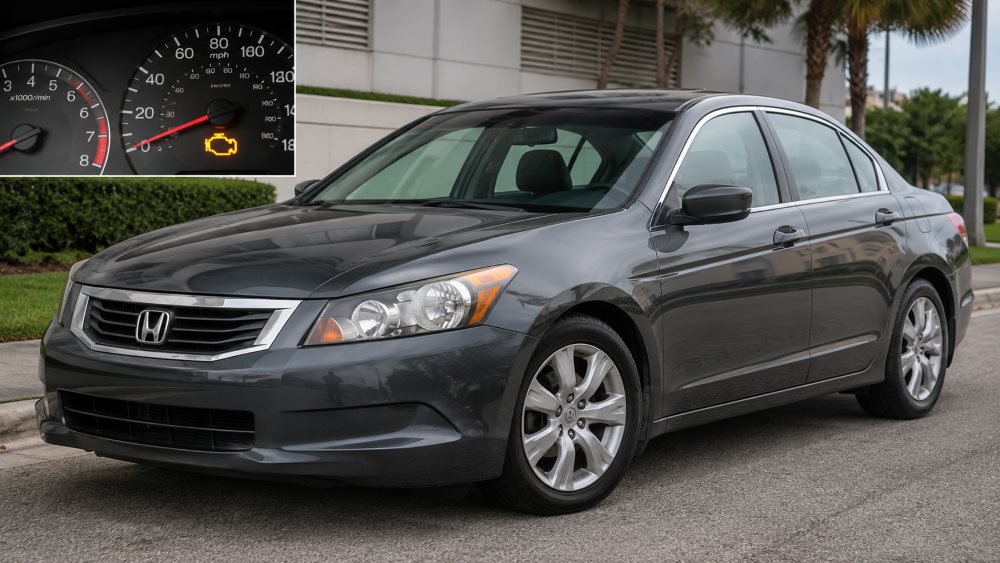
From the Brickell Honda Service Center - Last reviewed June 2026. Our Honda service technicians at 690 SW 8th St in Miami service eighth-generation Accords regularly and use professional Honda diagnostic equipment and Honda-specific scan capability where applicable to read and interpret the codes behind the check engine light. This guide covers common diagnostic patterns seen on 2008 Accord models in Miami-Dade County.
Note: Check engine light causes vary by vehicle condition, mileage, maintenance history, engine configuration, and individual diagnostic findings. The information here is general educational guidance. A professional diagnostic scan, ideally with Honda-specific scan capability where applicable, can help identify the specific fault and supporting data on your vehicle. Always consult a qualified technician for a vehicle-specific diagnosis.
The check engine light on a 2008 Honda Accord can point to dozens of possible faults, but certain patterns repeat often enough on eighth-generation Accords that experienced technicians know where to begin. A 2008 Accord with a check engine light in Miami may be dealing with one of several common issues: a power steering pressure circuit fault, oxygen or air/fuel sensor aging, a catalytic converter efficiency code, a VTEC oil pressure code tied to oil condition and maintenance history, or an EVAP-system issue such as a loose gas cap. This guide covers common causes, the OBD-II codes associated with each, what Miami driving conditions can contribute, and what to expect when you bring the car in for a professional diagnostic. For a broader look at check engine light causes across all Honda models, see our Honda check engine light guide for all models.
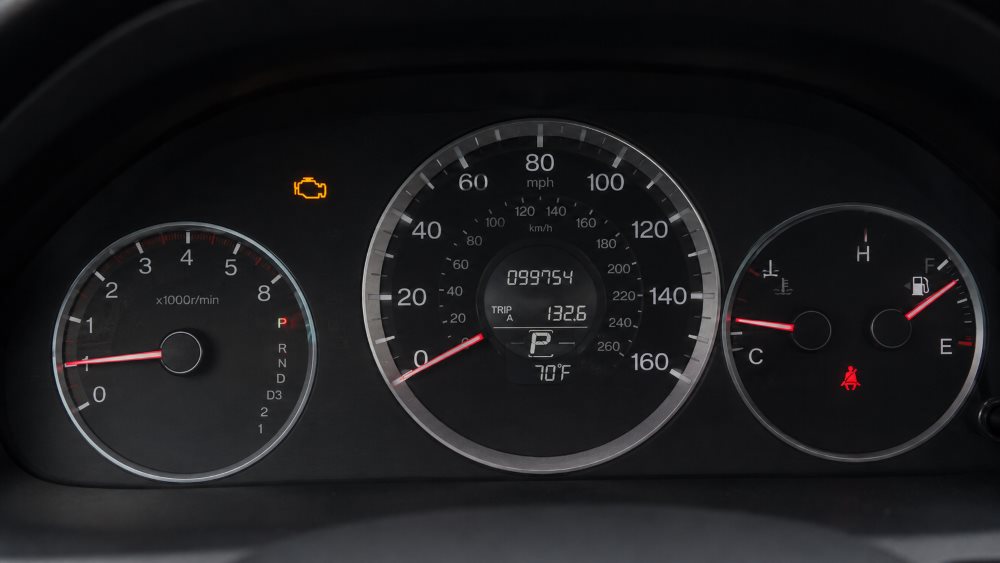
First: Solid Light vs. Flashing Light
The way the check engine light behaves tells you the most important thing before any code is read.
| Light Behavior | What It Suggests | What to Do |
|---|---|---|
| Solid (steady) | A stored fault code is present. The vehicle's computer has detected a condition outside normal parameters. It may not affect drivability immediately, but the underlying fault needs attention. | A steady check engine light often allows cautious driving for a short period, but the vehicle should be inspected promptly. Schedule a diagnostic appointment within a few days. |
| Flashing (blinking) | May indicate a severe engine misfire occurring in real time. A misfiring cylinder can cause unburned fuel to enter the catalytic converter, potentially causing damage. | Stop in a safe place, avoid driving aggressively, and arrange service immediately. A flashing check engine light should be treated as urgent. |
Start Here: Loose or Faulty Gas Cap
Before scheduling a diagnostic, check the gas cap. A loose, cracked, or missing gas cap is the single simplest cause of a check engine light on many vehicles - including the 2008 Accord. The vehicle's evaporative emission control (EVAP) system monitors for fuel vapor leaks, and an improperly sealed gas cap can trigger a stored code, often P0457, P0455, or P0442.
Remove the gas cap, inspect the rubber seal for cracks, reinstall it firmly until it clicks, and drive normally. The 2008 Accord owner's manual notes that the malfunction indicator lamp should go off after several days of normal driving once the fuel cap is tightened or replaced. If the light clears on its own, the gas cap may have been the cause. If it returns or does not clear, a diagnostic scan is the next step. In Miami's heat and humidity, gas cap seals can degrade faster than in cooler climates.
Common 2008 Honda Accord Check Engine Light Causes
1. Power Steering Pressure Circuit (P0551 / P0552)
One issue technicians may check on some eighth-generation Accords is the power steering pressure switch or related circuit. The 2008 Accord uses variable power-assisted rack-and-pinion steering, and a pressure switch or related circuit fault can trigger a check engine light without an obvious change in steering feel. The associated codes are typically P0551 (power steering pressure sensor circuit range/performance) or P0552 (power steering pressure sensor circuit low input).
A stored P0551 or P0552 on a 2008 Accord does not automatically mean the entire power steering pump has failed. A technician should verify switch output, wiring condition, connector condition, and related data before recommending parts replacement. Miami stop-and-go traffic on I-95, US-1, and the Dolphin Expressway means the steering system works frequently at low vehicle speeds, which puts more repeated demand on the pump and pressure circuit than steady highway driving does.
2. Oxygen Sensor or Air/Fuel Sensor Codes (P0136, P0141, P0156, P0161)
Depending on engine configuration, the 2008 Accord uses upstream and downstream oxygen or air/fuel sensors to monitor fuel control and catalytic converter efficiency. On a 2008 Accord with significant mileage, downstream sensor faults are common enough to check carefully, typically generating codes in the P013x or P015x range depending on the engine, bank, and sensor involved.
A failing downstream sensor can generate codes that resemble catalytic converter efficiency faults - distinguishing between a bad sensor and a genuinely failing converter requires live data analysis, not just a code read. Miami's heat can accelerate sensor and wiring degradation, and connector corrosion from humidity can generate intermittent sensor codes before the sensor itself fully fails.
3. Catalytic Converter Efficiency (P0420 / P0430)
P0420 (catalyst system efficiency below threshold, bank 1) and P0430 (bank 2) are common check engine codes on many high-mileage vehicles. On a 2008 Accord, these codes can become more common as mileage climbs and converter efficiency degrades with age and use.
P0420 and P0430 can also be caused by a failing downstream oxygen sensor - the code does not definitively mean the converter itself has failed. A proper diagnosis involves checking both the sensor and the converter before recommending replacement. Any catalytic converter replacement should use the correct part for the vehicle's engine, emissions configuration, and comply with applicable requirements.
4. VTEC Oil Pressure Switch / Solenoid (P2646 / P2647)
P2646 and P2647 are codes tied to Honda's Variable Valve Timing and Lift Electronic Control system. On the 2008 Accord, these codes can indicate a failing VTEC oil pressure switch or a condition that prevents proper oil pressure from reaching the VTEC solenoid.
The oil-pressure scenario is directly linked to maintenance history. Honda's 2008 Accord owner information specifies premium-grade 5W-20 detergent oil displaying the API Certification Seal. Vehicles that have gone too long between oil changes, used oil that did not meet the required specification, or operated with low oil levels can develop deposits that affect VTEC oil-pressure operation. A P2646 may require inspection of oil condition, service history, and oil-pressure behavior before a repair is recommended. Miami short-trip driving - where the engine may not fully heat-cycle - can accelerate oil degradation if oil changes are not kept current.
5. EGR System / Purge Valve (P0401, P0441, P1457)
P0401 (EGR flow insufficient) can point to a clogged EGR valve or passages restricted by carbon deposits. P0441 and P1457 relate to the EVAP system purge valve, canister, or vapor-control system and can appear as components age or stick. These codes are generally not urgent in terms of immediate drivability, but they should be diagnosed and repaired rather than repeatedly cleared.
6. Ignition Misfire (P0301–P0306)
Cylinder-specific misfire codes indicate that one or more cylinders are not firing consistently. On a 2008 Accord with 100,000 or more miles, worn spark plugs are one common cause. A cylinder-specific misfire code paired with a flashing check engine light indicates an active misfire - reducing engine load, avoiding highway speeds, and arranging prompt service is the appropriate response. Other misfire causes include failing ignition coils and, less commonly, fuel injector or mechanical issues.
7. Intake Air Measurement Faults (P0101 / P0102)
Air-measurement faults can produce symptoms alongside the check engine light - rough idle, hesitation on acceleration, or reduced fuel economy. The diagnostic approach may involve checking intake-air data, manifold pressure readings, intake leaks, wiring, connector condition, and sensor contamination. In Miami's humidity, intake and sensor-related components can develop deposits from moisture, dust, or age.
What Miami Driving Does to a 2008 Accord
Stop-and-go traffic and short trips. The Brickell, Downtown, and Coral Gables commute pattern - short distances, frequent stops, rarely reaching highway speeds - means the engine may not fully heat-cycle on every drive. This can contribute to faster oil degradation and increased carbon deposits on EGR passages and intake-related components over time.
Heat and humidity. South Florida's year-round heat puts sustained thermal stress on rubber components, wiring insulation, and sensor connectors throughout the exhaust and emissions systems. Oxygen sensor connectors, EGR vacuum lines, and EVAP canister hoses may degrade faster in Miami conditions than in more temperate climates.
Age and mileage. A 2008 Accord is now approaching 18 years old. Even a carefully maintained example has high-mileage systems throughout - catalytic converters, oxygen sensors, ignition components, wiring, hoses, and seals all have finite service lives.
What to Expect from a Diagnostic at Brickell Honda
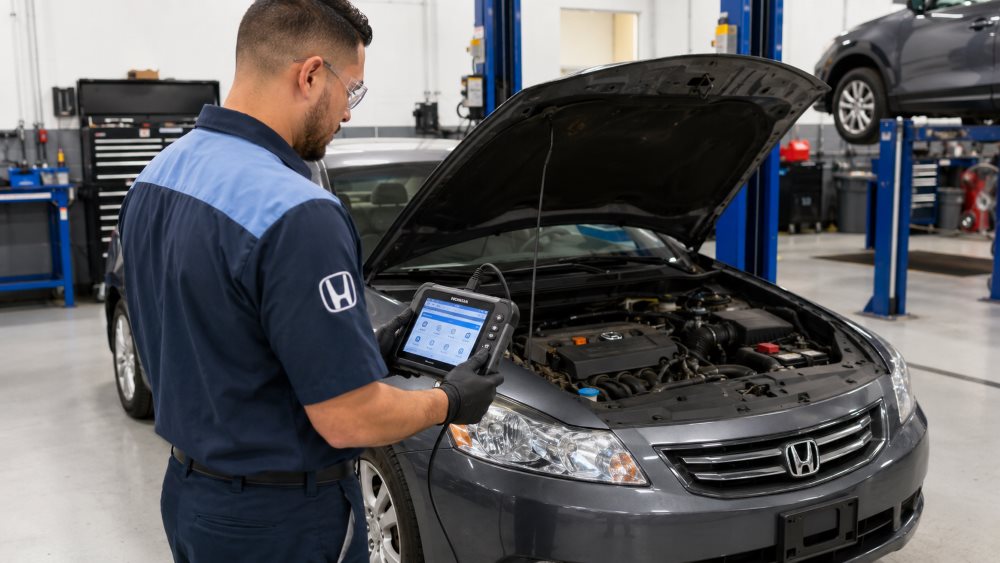
A diagnostic scan at Brickell Honda uses professional Honda diagnostic equipment and Honda-specific scan capability where applicable. The diagnostic process typically involves reading all stored and pending codes, reviewing freeze-frame data, and in many cases reviewing live sensor data to confirm whether a code reflects a current fault or a historical one. On a 2008 Accord with multiple stored codes, the sequence matters - sometimes one root cause generates several downstream codes.
For services with published pricing, check our current service specials page before scheduling, as offers and expiration dates may change. Diagnostic time for a check engine light is not always listed online - call 888-984-3851 for a current estimate.
Independent Shop vs. Honda Dealer for a 2008 Accord CEL
An independent shop can be a reasonable choice for: Reading a basic OBD-II code, replacing spark plugs on a confirmed misfire with a straightforward cause, replacing a gas cap, and performing routine maintenance.
A Honda dealer may be helpful for: Faults where Honda-specific scan data, Honda service information, or Genuine Honda parts are useful - especially VTEC oil-pressure faults, catalyst-efficiency diagnosis, and power steering pressure circuit codes where confirming the actual failed component before ordering parts matters.
Frequently Asked Questions
Can I drive my 2008 Accord with the check engine light on?
A steady check engine light often allows cautious driving for a short period, but the vehicle should be inspected promptly - within a few days rather than weeks. A flashing check engine light may indicate an active engine misfire. In that case, stop in a safe place, avoid driving aggressively, and arrange service immediately.
Why does the check engine light come on specifically after filling up with gas?
If the light appears shortly after a fill-up, one possible cause is an EVAP system fault related to the gas cap - codes such as P0442, P0455, or P0457. Try tightening the gas cap until it clicks. The 2008 Accord owner's manual notes that the malfunction indicator lamp should go off after several days of normal driving once the cap is tightened or replaced.
Is P0420 on my 2008 Accord definitely a catalytic converter?
Not necessarily. P0420 indicates catalyst efficiency below the threshold the ECU expects, but a failing downstream oxygen sensor can produce similar results. A proper diagnosis involves checking sensor response characteristics with live data before recommending converter replacement.
My 2008 Accord has P2646. What does that mean?
P2646 is a VTEC oil pressure switch or solenoid-related code. This can range from a straightforward switch or solenoid issue to an indication of oil-pressure or oil-condition problems. A technician should assess oil level, oil condition, maintenance history, wiring, and VTEC system operation before recommending a repair.
Does Florida require emissions testing if my check engine light is on?
Florida does not currently require routine emissions testing for standard private passenger-vehicle registration in Miami-Dade County. However, a check engine light means the vehicle has stored a fault code - the fault should be diagnosed for reliability, fuel economy, and drivability reasons, not simply cleared.
What if my Accord is a different year?
The eighth-generation Accord covers 2008–2012. Many faults described here may apply broadly to 2009, 2010, 2011, and 2012 models as well, though specific code patterns vary by year, engine, and trim. For other years, see our Honda check engine light guide for all models.
Schedule a Diagnostic at Brickell Honda
If your 2008 Honda Accord has an active check engine light, our Honda service team can scan the codes, review live data, and give you a clear picture of the likely fault before recommending any repair. Call 888-984-3851 to discuss what you are seeing, or schedule online.
Service Department: 888-984-3851
Service Hours: Mon-Fri 7:00 AM-6:00 PM | Sat 8:00 AM-6:00 PM | Sun 9:00 AM-3:00 PM
Address: 690 SW 8th St, Miami, FL 33130-3397
About Brickell Honda Service Center
Brickell Honda is a Honda dealership serving Miami and Miami-Dade County at 690 SW 8th St in Brickell. Our service department is staffed by Honda service technicians using professional Honda diagnostic equipment, with access to Genuine Honda Parts for recommended repairs where applicable. We serve drivers throughout Brickell, Downtown Miami, Coconut Grove, Coral Gables, Wynwood, Little Havana, and greater Miami-Dade County.
This guide reflects diagnostic patterns commonly observed in Miami service settings and is intended as general educational information. Warning light causes and diagnostic findings vary by vehicle condition, mileage, maintenance history, engine configuration, and individual diagnostic results. This article should not be used as a substitute for a vehicle-specific diagnosis by a qualified technician. Pricing references, coupons, and service offers are subject to change - verify current offers at our specials page before scheduling. Published June 2026 · Last reviewed June 2026.