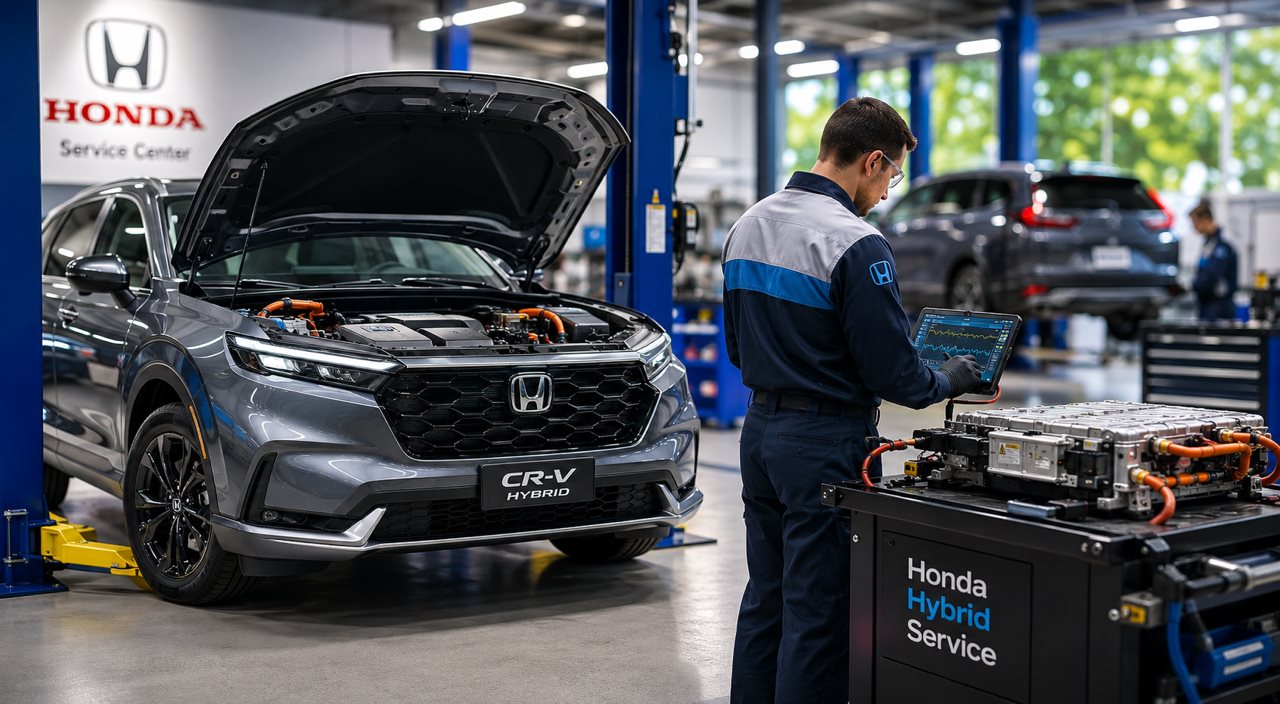
About this guide: This article reflects hybrid battery patterns observed on Honda vehicles serviced in our Miami service bay, anchored to Honda's published warranty terms and service information. Cost figures are general industry ranges, not Brickell Honda quotes - for a price specific to your vehicle, contact our service team. Last reviewed: May 2026.
Honda hybrid battery replacement generally runs somewhere between roughly $2,000 and $7,000 or more installed, depending on three things: your model, your battery type (the older IMA nickel-metal-hydride packs in earlier Civic Hybrids and Insights typically cost less than the newer lithium-ion packs in current Accord, CR-V, and Insight hybrids), and whether a new or Honda remanufactured pack is used. But before you authorize anything, check your warranty first. In Florida, Honda hybrid batteries are covered for 8 years or 100,000 miles under Honda's High-Voltage Battery Limited Warranty - and a meaningful share of replacements fall inside that window at no cost to the owner. Call Brickell Honda Service at (786) 628-0577 for a quote specific to your vehicle and to confirm your warranty status before paying out of pocket.
This guide covers what hybrid battery replacement costs by model, how to tell whether your battery is actually failing, how to check your warranty (the step most owners skip), the difference between new, remanufactured, and reconditioned batteries, and why Miami's heat is one of the hardest environments in the country on a hybrid battery.
What a Honda Hybrid Battery Actually Is (and Which One You Have)
"Hybrid battery" can mean two very different things on a Honda, and the distinction drives the cost.
Honda has used two generations of hybrid technology. The first is IMA (Integrated Motor Assist), which paired a small electric motor with a nickel-metal-hydride (NiMH) battery pack. IMA appeared in the first- and second-generation Insight, the Civic Hybrid (roughly 2003–2015), the early Accord Hybrid (2005–2007), and the CR-Z. NiMH packs are generally smaller and less expensive to replace than the newer technology.
The second is Honda's two-motor hybrid system (commonly referred to as i-MMD), which uses a more powerful lithium-ion battery. This is what's in the Accord Hybrid (2014 and newer), the CR-V Hybrid (2020 and newer), the third-generation Insight (2019–2022), and the Civic Hybrid that returned for the 2025 model year. Lithium-ion packs are larger, more sophisticated, and generally more expensive to replace.
Important distinction: Your hybrid has two batteries. The large traction battery (the one this article is about) powers the hybrid system. There's also a separate 12-volt battery that runs the lights, electronics, and computers - the same kind of battery a non-hybrid car has. A dead 12V battery is a common, inexpensive fix and is often mistaken for a "hybrid battery" failure. If your hybrid won't power on at all, the culprit is frequently the 12V battery, not the expensive traction pack. It's worth having both checked before assuming the worst.
What Honda Hybrid Battery Replacement Costs
The honest answer is that cost varies more than most owners expect, because it depends on battery type, whether the pack is new or remanufactured, your specific model, and labor. The ranges below are general industry figures for context only - not Brickell Honda quotes, and your actual cost may fall outside them. The only way to get a real number is a vehicle-specific estimate.
Before you assume you'll pay anything: if your vehicle is within 8 years / 100,000 miles, the high-voltage battery may be covered under warranty at no cost. Always confirm your warranty status and request a written estimate before authorizing work.
| Battery Type | Found In (examples) | Representative Cost Range (installed, general industry figures) |
|---|---|---|
| IMA (NiMH) | Civic Hybrid (~2003–2015), Insight (1st/2nd gen), early Accord Hybrid, CR-Z | Generally lower - often in the rough range of $2,000–$3,500 depending on new vs. remanufactured and labor (remanufactured NiMH packs sit at the lower end before labor) |
| Two-motor (Li-ion) | Accord Hybrid (2014+), CR-V Hybrid (2020+), Insight (2019–2022), Civic Hybrid (2025+) | Generally higher - often in the rough range of $3,000–$7,000+ depending on new vs. remanufactured pack and labor (higher end reflects new OEM lithium packs plus high-voltage diagnostic and labor) |
A few things drive where you land in those ranges. A new Honda pack costs more than a Honda remanufactured pack, which Honda builds to a factory standard and warranties. Labor varies by how the pack is packaged in your specific model. And aftermarket or independently reconditioned options exist at lower prices, with trade-offs we cover further down. For a figure specific to your Honda, call (786) 628-0577 and our team can provide a written estimate after confirming your model, battery type, and warranty status.
Check Your Warranty First - You May Owe Nothing
This is the single most important section of this guide, and it's the step most owners skip.
Honda hybrid traction batteries carry a longer warranty than most car parts - but it's worth being precise about which warranty. The 8-year / 100,000-mile coverage comes from Honda's High-Voltage Battery Limited Warranty, not the federal emissions warranty (which covers components like the catalytic converter and engine control module on a different, shorter term). In Florida, the high-voltage hybrid battery is covered for 8 years or 100,000 miles, whichever comes first, under Honda's High-Voltage Battery Limited Warranty. If your Honda hybrid is inside that window and the traction battery has genuinely failed, the replacement may be covered at no cost to you - an authorized Honda dealer can officially verify eligibility and process any applicable warranty claim.
An important expectation-setter: the warranty is intended to cover defects or abnormal battery degradation identified through Honda diagnostic testing and warranty criteria, rather than the gradual and expected reduction in battery capacity that naturally occurs over time and with normal vehicle use. A small drop in fuel economy or electric range around year 6 or 7 doesn't automatically mean a free battery. The diagnostic determines whether the loss qualifies.
A few more details worth knowing:
- Florida follows the standard (non-CARB) term. Some states that have adopted California emissions rules extend high-voltage battery coverage to 10 years / 150,000 miles. Florida is not one of them, so the 8-year / 100,000-mile coverage applies here.
- The 8-year clock starts at original in-service date, not your purchase date if you bought the car used. A used hybrid you bought three years ago may have more - or less - warranty remaining than you'd assume.
- Coverage applies to the high-voltage traction battery, not the 12V battery. The small 12V battery is a normal wear item with a standard warranty, not the 8-year high-voltage coverage.
- Extended and certified pre-owned warranties may add coverage beyond the standard term. If you bought a Honda Certified Pre-Owned hybrid or purchased an extended plan, your hybrid battery coverage may be longer.
Before you authorize any paid hybrid battery work - at our dealership or anywhere else - confirm your warranty status. Our service team can look up your vehicle's in-service date and coverage when you call. It's a short conversation that can save thousands of dollars.
Signs Your Honda Hybrid Battery Is Failing
Hybrid batteries rarely fail all at once. They degrade gradually, and the early signs are easy to miss or attribute to something else. Commonly observed symptoms include:
- Declining fuel economy. Often the first sign. If your Accord Hybrid or CR-V Hybrid is delivering noticeably worse mileage than it used to with no change in driving, a weakening battery may be the cause.
- A charge gauge that rises and falls rapidly. A healthy hybrid battery holds and releases charge smoothly. A pack with worn cells may show the state-of-charge indicator swinging up and down quickly, sometimes called "rubber-banding."
- Reduced electric assist or EV-only operation. The gas engine running more than it used to, or the car rarely operating on electric power alone, can indicate the battery is no longer holding a useful charge.
- The IMA light or hybrid system warning light. On IMA-equipped Hondas, an illuminated IMA indicator points directly to the hybrid system. On newer models, a hybrid system warning message appears in the multi-information display.
- The check engine light, sometimes alongside the IMA or hybrid light. Hybrid battery faults often set diagnostic trouble codes that illuminate the check engine light. Our companion guide on Honda check engine lights covers how to tell what's behind it.
- The battery cooling fan running loudly or constantly. Honda hybrids cool the battery with a fan, often drawing cabin air. A fan that runs hard or frequently can indicate the pack is working harder or running hotter than normal.
Several of these symptoms overlap with other issues - a failing 12V battery, a dirty battery cooling vent, or routine sensor faults. A proper diagnosis with Honda diagnostic equipment is what separates a genuine traction battery failure from a cheaper fix. If you're seeing any of these signs, having the system scanned before assuming a full battery replacement is the prudent first step.
Honda Hybrid Battery by Model
The fundamentals are the same across the lineup, but the specifics differ by model and generation.
Honda Civic Hybrid
The Civic Hybrid sold from roughly 2003 to 2015 used the IMA system with a NiMH battery. These are among the more affordable Honda hybrid batteries to replace, and remanufactured options are widely available. The 2006–2011 generation in particular is one we see frequently - many are now well past the 8-year warranty window, so owners are typically paying out of pocket. The Civic Hybrid returned for the 2025 model year with Honda's current two-motor lithium-ion system, which carries the longer, more modern battery and the full Honda High-Voltage Battery Limited Warranty for new buyers.
Honda Accord Hybrid
The early Accord Hybrid (2005–2007) used IMA. The modern Accord Hybrid returned for the 2014 model year and has continued in later generations using Honda's two-motor hybrid system. Many earlier examples of the modern Accord Hybrid are now approaching or passing the 8-year / 100,000-mile mark, which is exactly when battery questions tend to come up. If your Accord Hybrid is near that threshold and showing symptoms, checking your warranty status promptly matters - the difference between being just inside or just outside the window can be thousands of dollars.
Honda CR-V Hybrid
The CR-V Hybrid launched in the US for the 2020 model year with the two-motor lithium-ion system. As the newest of the high-volume Honda hybrids, most CR-V Hybrids on the road today are still well within the 8-year / 100,000-mile high-voltage battery warranty. If you own a CR-V Hybrid and are seeing hybrid system symptoms, there's a good chance the battery is still covered - confirm before paying.
Honda Insight
The Insight has had three distinct generations: the original 1999–2006 and the 2010–2014 second generation both used IMA with NiMH batteries, while the third-generation 2019–2022 Insight used the two-motor lithium-ion system. Replacement cost depends heavily on which generation you have - the older IMA packs are generally less expensive, the newer lithium-ion pack more. Insight-specific battery searches are common, and the generation gap is the single biggest cost variable.
A note on the Honda Prologue
The Honda Prologue is a fully electric vehicle, not a hybrid. It doesn't have a hybrid traction battery in the sense this article describes - it has a full EV battery pack with its own separate warranty terms and service considerations. If you own a Prologue, hybrid battery replacement cost doesn't apply to you; EV battery service is a different topic.
Why Miami's Heat Is Hard on Hybrid Batteries
Here's something the national cost-estimate sites won't tell you: where you live affects how long your hybrid battery lasts, and Miami's sustained heat and humidity can accelerate long-term battery degradation compared to cooler climates.
Heat is the primary enemy of both NiMH and lithium-ion batteries. Sustained high temperatures accelerate the chemical degradation that reduces a battery's capacity over time. Miami's combination of year-round heat, intense sun, and high humidity creates conditions that commonly shorten hybrid battery life compared to temperate or cold climates - which is counterintuitive to many owners who associate battery trouble with cold winters.
Heat soak in parked cars
A Honda hybrid parked outside in a Brickell garage rooftop, a Coconut Grove driveway, or a surface lot near the bay can reach extreme interior temperatures in the Miami sun. That heat soaks into the battery pack. Repeated, prolonged heat exposure is harder on long-term battery health than the heat generated during normal driving. Parking in shade or a covered garage when possible genuinely helps.
The battery cooling system matters more here
Honda hybrids cool the traction battery with a fan that typically draws cabin air through a vent, often located near the rear seat or parcel shelf. In Miami, two things commonly compromise that system: dust and debris blocking the intake vent, and the simple fact that the "cool" cabin air being drawn in is warmer here than it would be up north. There's an upside to this design worth knowing: running your A/C cools the cabin, which in turn feeds cooler air to the battery's intake vent. A good rule of thumb - if you're comfortable in the cabin, your hybrid battery is generally running in a healthier temperature range too. Keeping the battery cooling vent clear of obstructions - bags, debris, pet hair - is a small maintenance habit that matters more in this climate than almost anywhere else.
Short-trip city driving compounds it
Stop-and-go driving from Brickell to Wynwood or through downtown keeps the hybrid system cycling frequently without the steady highway operation that lets the battery and its cooling system settle into an efficient rhythm. Combined with heat, frequent short trips add stress over the life of the pack.
None of this means a Miami Honda hybrid battery will fail early - many last well beyond their warranty. But it does mean that treating heat management seriously, and not ignoring early symptoms, pays off more here than in milder climates.
New vs. Remanufactured vs. Reconditioned: Your Options
When a hybrid battery does need replacement and warranty doesn't apply, you have a few paths, and we'll be straight about the trade-offs.
New Honda battery. A brand-new pack from Honda, with full Honda warranty coverage. The most expensive option, and the most straightforward - new cells, factory specification, dealer-backed warranty.
Honda remanufactured battery. Honda rebuilds these to a factory standard and backs them with a warranty. Typically less expensive than new while still being a Honda-engineered, dealer-supported solution. For many out-of-warranty owners, this is the sensible middle path.
Independently reconditioned or aftermarket battery. Various independent shops offer reconditioned packs or individual module replacement, often at the lowest upfront price. The trade-offs: warranty terms vary widely, quality depends heavily on the shop, and a pack that's had only some cells or modules replaced may have a shorter remaining life than a fully remanufactured one. For an older Civic Hybrid you plan to keep only a year or two, this can be a reasonable economic choice. For a newer vehicle you intend to keep long-term, the cost difference may not be worth the risk.
There's no single right answer - it depends on your vehicle's age, how long you plan to keep it, and your risk tolerance. We're happy to talk through which option makes sense for your situation honestly, including when the cheaper route is the smarter one.
Dealer vs. Independent for Hybrid Battery Work
We're a Honda dealer, so you'd expect us to say "always come to the dealer." We won't.
An independent hybrid specialist can be a reasonable choice when your Honda is well out of warranty, you've found a shop with strong reviews and genuine hybrid experience, and you're comfortable with their warranty terms. For an older, high-mileage Civic Hybrid or Insight where the goal is the most economical path to a few more years of service, a reputable independent can do good work for less.
A Honda dealer is the better choice in several situations. If your vehicle is within the 8-year / 100,000-mile warranty, an authorized dealer can officially verify eligibility and process any applicable warranty coverage - and that coverage may make the replacement free. If you want a new or Honda remanufactured pack with Honda-backed warranty, that's dealer territory. And hybrid system diagnosis using the Honda Diagnostic System (HDS) is what accurately distinguishes a true traction battery failure from a cheaper fix - replacing a battery that didn't actually need replacing is the most expensive mistake in this whole category, and proper diagnosis prevents it.
Our straightforward advice: start by confirming your warranty status, then get a proper diagnosis before authorizing any replacement. Those two steps protect you from both unnecessary work and from paying for something that's covered. Call (786) 628-0577 and we can help with both.
How to Extend Your Honda Hybrid Battery's Life in Miami
You can't stop a hybrid battery from aging, but in this climate a few habits genuinely help:
- Park in shade or covered parking when you can. Reducing heat soak is the single most effective thing a Miami hybrid owner can do for long-term battery health.
- Keep the battery cooling vent clear. Don't block the intake (often near the rear seat or parcel shelf) with bags or cargo, and have it checked and cleaned periodically - debris buildup is common and reduces cooling efficiency.
- Don't ignore early symptoms. Declining fuel economy or a swinging charge gauge caught early sometimes points to a cooling or sensor issue that's far cheaper to address than a degraded pack.
- Keep up with scheduled maintenance. A healthy hybrid system depends on more than the battery. Following your Maintenance Minder schedule keeps the whole system in good condition.
- Drive it regularly. Hybrid batteries don't like sitting unused for long stretches. If you travel often and leave the car parked, that's worth factoring in.
Frequently Asked Questions
How much does a Honda hybrid battery replacement cost?
It depends on your model and battery type. Older IMA (nickel-metal-hydride) batteries in earlier Civic Hybrids and Insights are generally less expensive - often in the rough range of $2,000–$3,500 installed - while the newer lithium-ion packs in current Accord, CR-V, and Insight hybrids generally run higher, often $3,000–$7,000 or more. These are general industry ranges, not specific quotes; actual cost depends on new versus remanufactured pack and labor. And if your vehicle is within 8 years / 100,000 miles, it may be covered under Honda's High-Voltage Battery Limited Warranty. Call us for a quote specific to your Honda.
Is my Honda hybrid battery still under warranty?
In Florida, Honda hybrid batteries are covered for 8 years or 100,000 miles, whichever comes first, under Honda's High-Voltage Battery Limited Warranty. The clock starts at the vehicle's original in-service date, not your purchase date. If you bought the car used, it may have more or less coverage remaining than you'd expect. An authorized Honda dealer can look up your exact coverage - it's worth confirming before paying for anything.
How long do Honda hybrid batteries last?
Many Honda hybrid batteries last well beyond the 8-year / 100,000-mile warranty period, though lifespan varies significantly by climate, usage, and maintenance. Heat shortens that lifespan, which is why Miami owners may see batteries age somewhat faster than owners in cooler climates. There's no fixed expiration date; condition matters more than age alone.
What are the signs my hybrid battery is failing?
The most common early signs are declining fuel economy, a charge gauge that rises and falls rapidly, the gas engine running more than usual, and the IMA or hybrid system warning light. The check engine light may also appear. Because several of these overlap with cheaper issues - including a failing 12V battery - a proper diagnosis is what confirms whether the traction battery is actually the problem.
Can I drive my Honda with a failing hybrid battery?
In many cases the car will still run, because the gas engine can operate even when the hybrid battery is weak - but you'll typically see worse fuel economy and reduced performance, and warning lights present. We'd recommend having it diagnosed promptly rather than driving on it indefinitely, since some hybrid faults can affect drivability and a proper diagnosis prevents the symptoms from being misattributed to a more expensive problem.
Is a hybrid battery the same as the 12V battery?
No. Your hybrid has two separate batteries: the large traction battery that powers the hybrid system (covered 8 years / 100,000 miles in Florida), and a smaller 12V battery that runs the lights, electronics, and computers (a normal wear item with a standard warranty). A dead 12V battery is a common and inexpensive issue that's frequently mistaken for a hybrid battery failure. If your hybrid won't power on, the 12V battery is often the culprit - worth checking before assuming the worst.
Does Miami heat really shorten hybrid battery life?
Heat is the primary factor in long-term hybrid battery degradation, so yes - Miami's sustained high temperatures can shorten battery life compared to cooler climates. This surprises owners who associate battery problems with cold. Parking in shade, keeping the battery cooling vent clear, and addressing symptoms early all help offset the climate's effect.
Should I replace the hybrid battery or buy a new car?
It depends on the vehicle's overall condition, mileage, and how long you plan to keep it. For a Honda that's otherwise in good shape with reasonable mileage, a battery replacement - especially a Honda remanufactured pack - is often far cheaper than replacing the whole car and can add years of service. For a high-mileage vehicle with other looming repairs, the math may favor replacement. We're happy to give you an honest assessment for your specific situation rather than a one-size-fits-all answer.
Does Brickell Advantage cover hybrid battery replacement?
Brickell Advantage covers scheduled maintenance items (oil changes and the like) for the first 2 years or 24,000 miles - it's a maintenance program, not a repair warranty, so it does not cover hybrid battery replacement. The coverage that may apply to your hybrid battery is the separate Honda High-Voltage Battery Limited Warranty (8 years / 100,000 miles in Florida). Our advisors can confirm which coverage applies to your specific situation.
Can I replace a Honda hybrid battery myself?
We'd strongly advise against it. Hybrid traction batteries operate at high voltage and require specific safety procedures, insulated tools, and training to service safely. This is genuinely dangerous work for an untrained person, and improper handling carries serious risk of injury. Hybrid battery service should be performed by trained technicians with the right equipment.
Schedule Your Honda Hybrid Service in Miami
If your Honda hybrid is showing symptoms - declining fuel economy, a flickering charge gauge, an IMA or hybrid system warning light - the smartest first move is a proper diagnosis and a warranty check before any replacement is authorized. Our Honda-trained team uses the Honda Diagnostic System (HDS) to confirm whether the traction battery is genuinely the problem, and we can look up your warranty status to see whether a replacement would be covered at no cost.
Service Department: (786) 628-0577
Service Hours: Monday–Friday 7:00 AM – 6:00 PM | Saturday 8:00 AM – 6:00 PM | Sunday 9:00 AM – 3:00 PM
Address: 690 SW 8th St, Miami, FL 33130
Cost figures in this article are general industry ranges for context only and are not Brickell Honda quotes. Actual cost varies by model, battery type, new versus remanufactured pack, and labor. Warranty coverage depends on your vehicle's in-service date and history. Consult a Honda-certified technician at Brickell Honda for a vehicle-specific assessment and written estimate. Final recommendations may vary by vehicle condition and advisor. Offer terms and expiration dates may change without notice - verify current offers directly on our specials page before scheduling.
About Brickell Honda Service Center
Brickell Honda has served Miami-Dade County Honda owners from 690 SW 8th St in Miami. Operated by Murgado Automotive Group, our service department includes ASE-certified and Honda-factory-trained technicians equipped with the Honda Diagnostic System (HDS) and the OEM tooling required for safe, accurate diagnosis of Honda hybrid systems - including IMA-equipped models (earlier Civic Hybrid, Insight, CR-Z) and the two-motor hybrid systems in the Accord Hybrid, CR-V Hybrid, and current Civic Hybrid. Eligible new Honda purchases may include Brickell Advantage coverage, subject to program terms, covering scheduled maintenance for 2 years or 24,000 miles. We maintain authorized dealer designation from Honda and carry strong customer-review track records on DealerRater and Yelp.
This guide reflects hybrid battery patterns observed in our Miami service bay and is intended as educational information. Cost figures are general industry ranges, not Brickell Honda quotes. For service planning and pricing specific to your vehicle, consult a Honda-certified technician. Final recommendations may vary by vehicle condition and advisor. Published May 26, 2026 · Last reviewed May 2026.