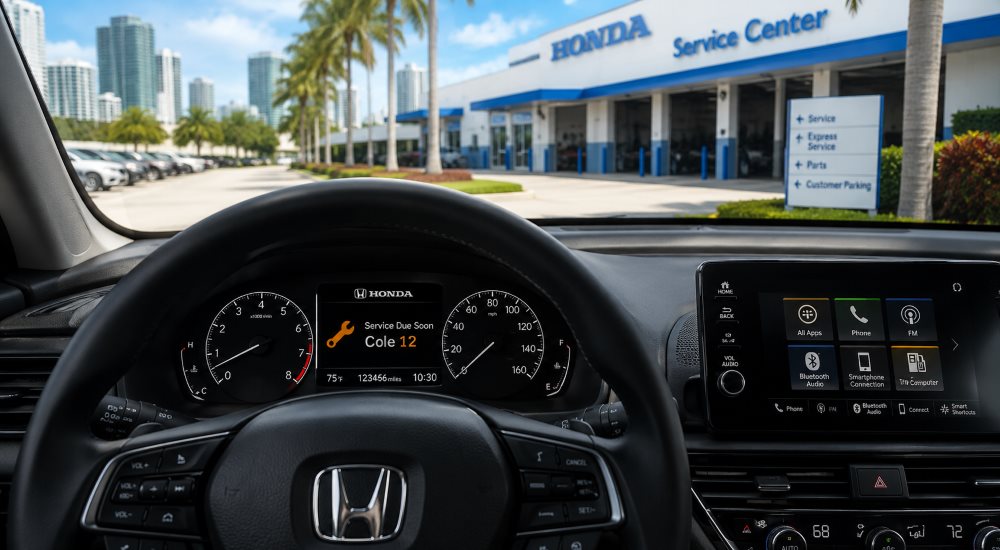
About this guide: This article reflects common Maintenance Minder patterns observed on Honda vehicles serviced in our Miami service bay, anchored to Honda's owner's manual definitions. For a service plan specific to your vehicle, contact the service team at Brickell Honda. Last reviewed: May 2026.
The amber wrench icon on your Honda dashboard with a code like A1, B12, or B125 isn't a fault - it's the Honda Maintenance Minder telling you which service items are due. The letter tells you whether it's an oil-only service (A) or oil plus a comprehensive inspection (B). The numbers that follow are sub-codes that flag additional items - tire rotation, air filters, transmission fluid, spark plugs, coolant, or rear differential fluid - bundled into the same visit. The Maintenance Minder adjusts for operating conditions, but it can't directly measure oil quality, brake wear, fluid contamination, or how Miami-specific driving patterns affect long-term component wear - so understanding what it's actually telling you (and what it isn't) matters. Call Brickell Honda Service at (786) 628-0577 if you'd like a Honda-trained advisor to read the code with you.
This guide covers what every Maintenance Minder code means, how to read and reset the system across Honda models from 2006 to current, how Miami's climate affects service intervals, what's covered free for the first two years under Brickell Advantage, and when the dealer is the right call versus when an independent shop is fine.
What the Honda Maintenance Minder System Actually Tracks
Honda introduced the Maintenance Minder system on 2006 model-year Civics and rolled it out across the lineup over the next several years. By 2009, nearly every Honda sold in the United States included it. The system replaced the older "service every 7,500 miles" sticker on the windshield with something more responsive - an algorithm that monitors actual driving conditions and adjusts service timing based on how the vehicle is being used.
The Maintenance Minder calculates oil life based on factors including engine revolutions, oil temperature, ambient temperature exposure, and operating duty cycle. It does not directly measure oil quality or oil level - it estimates remaining oil life from how hard the engine has been working. A Honda driven mostly at steady highway speeds will see its oil life percentage drop slowly; a Honda used primarily for short city trips in extreme heat will see it drop noticeably faster.
Important to know: The Maintenance Minder does not measure brake pad thickness, tire tread depth, battery condition, or fluid levels directly. It schedules these items at expected intervals, but a visual inspection by a technician is what actually confirms condition. If your driving conditions cause brake pads to wear faster than the system anticipates - which is common in Miami's stop-and-go traffic - you may need brake service before the Maintenance Minder calls for it.
Code A vs. Code B: The Main Service Codes
Every Honda Maintenance Minder service code starts with either an A or a B. These two letters represent fundamentally different service scopes.
| Code | What's Included | Typical Interval |
|---|---|---|
| A | Replace engine oil and oil filter. | Every ~5,000–7,500 miles depending on driving conditions |
| B | Replace engine oil and oil filter, plus inspect: front and rear brakes, parking brake adjustment, tie rod ends, steering gearbox and boots, suspension components, driveshaft boots, brake hoses and lines, all fluid levels and condition, exhaust system, fuel lines and connections. | Typically appears around every 15,000 miles, or roughly twice per year for average drivers |
The Code B service is what some drivers call the "real" service - the comprehensive inspection is what catches brake wear, fluid contamination, suspension issues, and other things the Maintenance Minder algorithm itself can't detect. If you're going to skip an oil change, never skip a B. A simple oil change at a quick-lube facility doesn't include any of the B-service inspection items.
The Sub-Codes: What 1, 2, 3, 4, 5, and 6 Mean
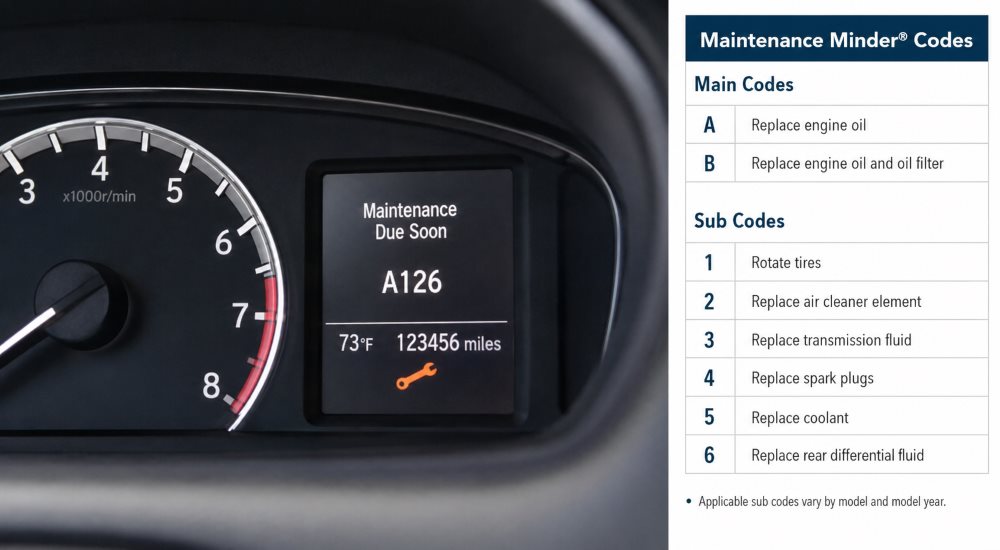
After the letter, the Maintenance Minder appends one or more digits indicating which additional service items are due. Each sub-code corresponds to a specific maintenance task with its own interval. Honda's owner's manual defines them as follows:
| Sub-Code | Service Item | Typical Interval |
|---|---|---|
| 1 | Rotate tires; inspect tread depth and pressure | Typically every other oil change (~10,000–15,000 miles) |
| 2 | Replace air cleaner element, cabin dust and pollen filter; inspect drive belt | Around 15,000–30,000 miles in normal conditions; may be sooner in Miami's pollen and humidity |
| 3 | Replace transmission fluid (and transfer case fluid on AWD models) | Around 30,000–60,000 miles depending on transmission type |
| 4 | Replace spark plugs; replace timing belt (where equipped); inspect water pump; inspect valve clearance | Around 60,000–100,000 miles depending on engine and plug type |
| 5 | Replace engine coolant | Initial replacement around 60,000–120,000 miles; subsequent replacements typically every 30,000 miles or per Honda Long Life Coolant specification |
| 6 | Replace rear differential fluid (AWD models only - Pilot, Passport, CR-V AWD, HR-V AWD, Ridgeline) | Around 30,000–60,000 miles depending on driving conditions |
A few notes on the sub-codes. The intervals in the table above are general ranges anchored to Honda's owner's manual; actual interval timing depends on the Maintenance Minder algorithm's reading of your specific driving conditions. The Maintenance Minder bundles sub-codes that come due around the same time, which is why you'll often see combined codes rather than individual ones.
Reading Combined Codes: What B125, A123, and B12345 Mean
Honda Maintenance Minder codes are read left to right. The letter comes first, then every applicable sub-code in numerical order. Here's how to translate the codes you're most likely to see:
| Code You See | What's Actually Due |
|---|---|
| A1 | Oil change + tire rotation. Common at every other oil change interval. |
| B1 | Oil + filter change + comprehensive inspection + tire rotation. A common "full service" visit. |
| B12 | Everything in B1 plus air and cabin filter replacement and drive belt inspection. Typically appears around 30,000-mile mark. |
| A123 or B123 | Oil service (A or B) + tire rotation + air/cabin filters + drive belt + transmission fluid. Common around 60,000 miles. |
| B125 | B-service + tire rotation + air/cabin filters + engine coolant replacement. Often the "first big service" milestone, typically around 60,000–100,000 miles. |
| B12345 | The "everything" service - B-service plus all sub-codes 1 through 5. Typically appears around the 100,000-mile mark and represents a major maintenance milestone. |
| B16 or B126 | AWD-model service codes including rear differential fluid. Seen on Pilot, Passport, CR-V AWD, HR-V AWD, Ridgeline. |
Two things worth knowing about how the codes appear. First, the Maintenance Minder algorithm doesn't display every sub-code that's hypothetically due - it shows what the system has scheduled for your specific vehicle based on its tracked mileage and conditions. A new Civic at 7,500 miles won't show sub-code 5 even though coolant will eventually need replacement. Second, the codes update in real time as items are completed and reset, so the next time you see a code may be different from what's displayed today.
How to Read the Maintenance Minder on Your Honda
The display location varies by model year and trim. Here's where to find it on the most common Honda generations.
2006–2015 Hondas (older multi-information display)
On most Hondas from this era, oil life percentage and Maintenance Minder codes appear on the smaller display between the speedometer and tachometer. Use the SEL/RESET button on the steering wheel or instrument panel to cycle through the available displays - you'll see odometer, trip A, trip B, fuel economy, and eventually the oil life and service code screen. The wrench icon illuminates as a warning indicator separately from the text display.
2016–2021 Hondas (i-MID with touchscreen)
Press the Home button on the touchscreen, then navigate to Settings → Vehicle → Maintenance Info. The screen displays each scheduled service item, its current status (active or reset), and the oil life percentage. Some trims also show this information on the driver's i-MID display reachable through steering-wheel arrow controls.
2022 and Newer Hondas (digital cluster)
Newer Hondas with the fully digital instrument cluster integrate Maintenance Minder information into the main display. Use the steering-wheel controls to cycle to the vehicle information screen, then drill down to maintenance details. On most 2023+ Accord, CR-V, and Pilot models, you can also access this through the central touchscreen menu under Vehicle Settings.
HondaLink app (2018+ models)
Many newer Hondas also push Maintenance Minder alerts to the HondaLink mobile app, which shows current oil life percentage, active service codes, and a maintenance history log. This is particularly useful for tracking which service codes have been resolved and when.
How to Reset the Maintenance Minder
When service is completed at our service department, the Maintenance Minder is reset automatically - you don't need to do anything. But if you've had service performed elsewhere or if you need to reset a sub-code yourself, the procedure varies by generation.
Method 1: Older Hondas (2006–2015, button reset)
- Turn the ignition to "ON" position (one click before start; engine not running).
- Press the SEL/RESET button on the dashboard or steering wheel until the engine oil life display appears.
- Press and hold SEL/RESET for approximately 10 seconds. The oil life percentage will begin blinking.
- Continue holding (or press again, depending on model) until the display resets to 100% and any service codes are cleared.
- Turn the ignition off, then back on to verify the reset took effect.
Method 2: Mid-Generation Hondas (2016–2021, menu reset)
- Press the Home button on the touchscreen.
- Navigate to Settings → Vehicle → Maintenance Info.
- Select the active service code or oil life entry.
- Confirm "Reset" when prompted.
Method 3: 2022+ Hondas (digital cluster reset)
- Access the vehicle information menu through the steering wheel controls or central touchscreen.
- Navigate to Maintenance or Service Info.
- Select the item to reset and confirm.
Important: Resetting the Maintenance Minder doesn't perform any maintenance - it only clears the reminder. If you reset the system without completing the service, you'll lose track of what's actually due, which can lead to skipped intervals and accelerated wear. We recommend resetting only after the corresponding service is performed.
Why Miami Drivers See Maintenance Minder Codes Earlier
The Maintenance Minder algorithm is calibrated for typical operating conditions, which Honda's engineers define as a blend of climate zones, driving patterns, and use cases across the United States. Miami's conditions are not typical, and the system reflects that - codes commonly appear earlier here than national-average mileage figures would suggest. Several factors contribute to this pattern.
Heat Accelerates Oil Breakdown
South Florida regularly sees ambient temperatures above 90°F for months at a time. At those temperatures, engine oil reaches higher operating temperatures and breaks down faster than it would in a temperate climate. The Maintenance Minder algorithm factors this in to some degree, but many technicians observe oil degradation patterns consistent with shorter service intervals in high-heat urban driving. Many experienced technicians view Miami driving conditions as closer to what Honda's historical schedules classified as severe service.
Humidity Stresses the Air and Cabin Filter Cycle
Miami's year-round humidity, combined with pollen and airborne particulates, means cabin air filters and engine air filters typically need replacement noticeably sooner than the national-average 30,000-mile interval Honda specifies. When sub-code 2 lights up, the air filter and cabin filter inside often look significantly degraded - what would last 30,000 miles in a dry climate may need replacement closer to 20,000 in coastal South Florida. See our companion guide on Honda AC service in Miami for more on how humidity affects HVAC components.
Coastal Salt Air Affects Brake and Drivetrain Components
Hondas driven or parked near Biscayne Bay, Key Biscayne, the Rickenbacker Causeway, or anywhere within a few miles of saltwater experience accelerated corrosion on brake hardware, suspension components, and electrical connectors. The Maintenance Minder's B-service inspection catches these conditions, but the wear itself happens faster than the algorithm anticipates. Our companion guide on Honda brake wear in Miami traffic covers this in more depth.
Short-Trip Downtown Driving Dilutes Oil
A commute from Brickell to Wynwood, or from the Financial District to Coconut Grove, is often under 10 miles. Modern Honda engines - particularly the 1.5L turbo found in many recent Civics, Accords, and CR-Vs - don't fully reach operating temperature on short trips, which allows unburned fuel to dilute the engine oil and reduces its protective properties. For drivers whose daily routes are primarily short downtown trips, our service team often recommends shortening the oil change interval beyond what the Maintenance Minder suggests. Our Miami Honda oil change guide walks through the specifics.
Honda OEM Recommendations vs. Additional Miami-Conditions Considerations
The schedule below distinguishes between what Honda specifies in the owner's manual and additional inspection items that are commonly observed to benefit Miami Honda owners. The intervals below are general estimates and may vary by vehicle, model year, driving habits, and vehicle load - your service advisor can build a plan specific to your Honda.
| Service Item | Honda OEM Recommended | Additional Miami-Conditions Considerations |
|---|---|---|
| Engine oil change | Per Maintenance Minder (typically 7,500 mi normal, sooner in severe) | Short-trip downtown driving may warrant 4,000–5,000 mile intervals regardless of Maintenance Minder |
| Air and cabin filters (sub-code 2) | Per Maintenance Minder (around 30,000 mi typical) | Inspection at every B-service is commonly recommended; replacement may be appropriate sooner due to humidity and pollen |
| Brake inspection | Part of B-service inspection | Visual inspection every 6,000–7,500 miles is commonly observed to be appropriate in stop-and-go Miami traffic |
| Battery testing | Not on Maintenance Minder schedule | Annual testing recommended - Miami heat is harder on batteries than cold; many vehicles may require battery replacement around year 3–4 depending on usage |
| AC system pressure check | Not on Maintenance Minder schedule | Every 2 years is commonly recommended given Miami's near-year-round AC use |
| Brake fluid replacement | Every 3 years per Honda owner's manual | Miami humidity accelerates moisture absorption in brake fluid; testing at every B-service is commonly recommended |
Brickell Advantage: What's Covered Free for 2 Years / 24,000 Miles
When you purchase or lease a new Honda from Brickell Honda, your scheduled maintenance is covered at no charge for the first 2 years or 24,000 miles, whichever comes first. This is the Brickell Advantage program - it's not a separate purchase, it comes standard with every new Honda.
What this means in practical terms for the Maintenance Minder: many of the services that come up under Maintenance Minder codes during the coverage period are covered at no charge. Coverage details may vary by specific code, model, mileage, and which maintenance items are included - items like air filters (sub-code 2), transmission fluid (sub-code 3), spark plugs (sub-code 4), engine coolant (sub-code 5), and rear differential fluid (sub-code 6) may have different coverage terms. Before your appointment, our service advisors can confirm which portions of your visit are included under Brickell Advantage.
What's typically not included: items beyond the standard maintenance schedule (brake repairs, tire replacements due to wear, anything caused by accident or misuse), and services performed at non-Brickell-Honda facilities. If you're a Brickell Honda customer within your first 24 months, our advisors can walk you through what Brickell Advantage covers for your specific Honda before you book.
When the Dealer Matters vs. When an Independent Shop Is Fine
We're a Honda dealer, so a section like this is one most readers expect us to slant. We won't.
An independent shop is genuinely fine for many Maintenance Minder services. An oil change service (code A or sub-code 1 alone) is straightforward work that any competent shop can handle correctly, often at lower labor rates than a dealer. The same is true for air filter replacement (sub-code 2) and basic tire rotation. If your Honda is out of warranty, out of Brickell Advantage coverage, and the Maintenance Minder is showing a simple code, an independent Honda specialist with good reviews is a reasonable choice.
A Honda dealer is the better choice in specific situations. Anything covered under your factory warranty or Brickell Advantage should be handled through an authorized Honda dealer so coverage can be verified and processed correctly. Honda Technical Service Bulletins (TSBs) and recalls are dealer-only territory. Honda-specific systems including Honda Sensing safety features, VTM-4 all-wheel drive on Pilot, hybrid drivetrain components on Civic Hybrid, Accord Hybrid, CR-V Hybrid, and Insight, the CVT transmission's specific service procedures, and the Honda Diagnostic System (HDS) used to read manufacturer-specific codes - these are areas where dealer access matters. For B-service inspections specifically, the difference between a dealer technician trained on Honda-specific patterns and an independent generalist can be meaningful.
Our straightforward suggestion to Brickell Honda customers: while you're still within the 2-year / 24,000-mile Brickell Advantage window, many of those services are covered - our team can confirm exactly what's included before you book. After that, for routine Maintenance Minder services, evaluate the convenience and pricing trade-offs honestly. For anything Honda-specific or warranty-related, we're built for it.
Frequently Asked Questions
Is it safe to drive with the Maintenance Minder showing on my Honda?
Yes. The Maintenance Minder is a service reminder, not a fault indicator. Your Honda's engine, transmission, brakes, and other systems are operating normally - the system is simply telling you scheduled maintenance is approaching or due. We'd recommend scheduling service within a few weeks rather than ignoring it for months, particularly for B-service codes where the comprehensive inspection catches developing issues.
What's the difference between the Maintenance Minder wrench icon and the check engine light?
On Hondas, the amber wrench icon is a maintenance reminder - not a fault warning. The check engine light (also amber, but a different symbol shaped like an engine outline) means the vehicle's computer has detected a fault that needs diagnostic attention. They look similar to drivers who aren't familiar with both, but they mean completely different things. Worth noting that the wrench icon means different things on other brands (on Ford, for example, the wrench typically indicates a powertrain fault - not a maintenance reminder). Our companion guide on Honda check engine lights covers that side in detail.
How do I know which sub-codes are due if I see "B12" on my display?
The letter and each digit refer to a specific service item, as the tables earlier in this guide describe. B12 means a B-service (oil and filter change plus comprehensive inspection), plus sub-code 1 (tire rotation) and sub-code 2 (air filter, cabin filter, drive belt inspection). Your Honda's owner's manual lists each sub-code definition; we can also confirm everything that's due when you book service.
Should I follow the Maintenance Minder or the mileage-based schedule in my owner's manual?
For 2006 and newer Hondas, follow the Maintenance Minder - it's calibrated to your actual driving conditions. The mileage-based schedule in the owner's manual is a fallback for owners whose vehicles don't have a working Maintenance Minder or who want to plan service in advance. The two should generally align, with the Maintenance Minder being more responsive to real-world driving.
Why does my Maintenance Minder come on earlier in Miami than my friend's same model in another state?
The Maintenance Minder algorithm responds to actual operating conditions - engine temperature, duty cycle, ambient heat exposure, and engine revolutions. Miami's heat, humidity, and stop-and-go traffic all push the algorithm toward earlier service intervals than a vehicle operated in moderate climates would see. This is the system working as designed; it's adjusting to your actual driving environment.
Can I just reset the Maintenance Minder myself without doing the service?
You can mechanically, but we'd strongly suggest against it. The system tracks oil life and scheduled service items to protect your engine and other components from wear they're not designed to handle. Resetting without doing the work means losing the visibility into what's actually due, which over time can lead to skipped intervals and accelerated wear. The Maintenance Minder is a tool to help your Honda last - clearing it without service defeats the purpose.
Does the Maintenance Minder track brake pad wear?
No. The Maintenance Minder schedules brake inspections as part of B-service intervals, but it doesn't directly measure pad thickness, rotor condition, or fluid level. In Miami's stop-and-go traffic, brake pads commonly wear faster than the system anticipates. A visual inspection - either at a Brickell Honda B-service or at an independent shop - is what actually confirms brake condition. See our Miami brake wear guide for more.
Is the Maintenance Minder the same on Honda hybrids?
The system is essentially the same on Civic Hybrid, Accord Hybrid, CR-V Hybrid, and Insight, with one important difference: the hybrid powertrain runs the gas engine less than a conventional Honda would for the same miles driven, which can mean longer oil change intervals on paper. However, when the engine does run, it cycles through more start/stop events, which is hard on oil in a different way. Many experienced technicians often recommend not extending hybrid oil change intervals significantly beyond what the Maintenance Minder displays, particularly in Miami's heat. The Honda Prologue is fully electric and uses a different service schedule entirely - no oil changes, but tire rotations, brake inspections, cabin filter, and high-voltage system checks remain on the schedule.
What happens to my Maintenance Minder if I disconnect the battery?
On most Hondas, disconnecting the battery doesn't erase the Maintenance Minder data - it's stored in non-volatile memory. However, disconnecting the battery does erase adaptive transmission learning, idle air volume learning, radio presets, and on Honda Sensing-equipped vehicles may require certain driver-assist systems to recalibrate. We don't recommend disconnecting the battery as a service workaround. Final recommendations may vary by vehicle condition and advisor - please consult your service advisor before disconnecting any battery on a Honda Sensing-equipped model.
Can I bring my Acura to Brickell Honda for Maintenance Minder service?
Honda and Acura share many platforms, engines, and the same Maintenance Minder system. While Brickell Honda is a Honda-authorized dealer and not an Acura dealer, our technicians are familiar with the Maintenance Minder system across both brands. For routine maintenance items, we can often help. For Acura-specific warranty work or Acura-only diagnostic procedures, an Acura dealer is the right choice.
Schedule Your Honda Maintenance Service in Miami

If your Honda's Maintenance Minder shows a code, our Honda-trained team is ready to handle it efficiently with Genuine Honda Parts and the Honda Diagnostic System (HDS). For Brickell Honda customers within the first 2 years or 24,000 miles, many scheduled Maintenance Minder services may be covered under the Brickell Advantage program - our service advisors can confirm what's included for your specific Honda before you book.
Service Department: (786) 628-0577
Service Hours: Monday–Friday 7:00 AM – 6:00 PM | Saturday 8:00 AM – 6:00 PM | Sunday 9:00 AM – 3:00 PM
Address: 690 SW 8th St, Miami, FL 33130
For routine maintenance items, our Honda Express Service can often handle Maintenance Minder code A and sub-code 1 visits without an appointment, though we recommend calling ahead to confirm wait times. For B-service and combined codes, scheduling an appointment in advance helps us reserve time for the comprehensive inspection.
Service intervals are general estimates and vary by model, trim, driving habits, and vehicle load. Consult a Honda-certified technician at Brickell Honda for a vehicle-specific assessment. Final recommendations may vary by vehicle condition and advisor. Offer terms and expiration dates may change without notice - verify current offers directly on our specials page before scheduling.
About Brickell Honda Service Center
Brickell Honda has served Miami-Dade County Honda owners from 690 SW 8th St in Miami. Operated by Murgado Automotive Group, our service department is staffed by ASE-certified and Honda-factory-trained technicians equipped with the Honda Diagnostic System (HDS) and OEM tooling required for accurate diagnosis of all Honda vehicles, including hybrid (Civic Hybrid, Accord Hybrid, CR-V Hybrid, Insight), AWD (Pilot, Passport, Ridgeline), and Honda Sensing-equipped models. New Honda purchases include Brickell Advantage, covering scheduled Maintenance Minder services for 2 years or 24,000 miles per program terms. We maintain authorized Honda dealer designation from American Honda Motor Co. and carry strong customer-review track records on DealerRater and Yelp.
Disclaimer:This guide reflects Maintenance Minder patterns observed in our Miami service bay and is intended as educational information. For service planning specific to your vehicle, consult a Honda-certified technician. Final recommendations may vary by vehicle condition and advisor. Published May 15, 2026 · Last reviewed May 26, 2026.